Executive Summary
- Vanguard, Russell Investments, Envestnet and Morningstar have each estimated the potential value of financial advice, and a Vanguard survey asked advised investors how advice affects their peace of mind.
- Vanguard's 2025 research puts the potential at up to, or more than, 3% in net returns over an unspecified period, with the largest opportunities arriving intermittently rather than every year.
- Russell's 2026 study estimates the potential value of an advisor at 4.92%, with behavioral coaching the largest part at 2.30%. Russell calls its figures hypothetical projections, not a guarantee of results.
- Together, the studies cover six areas - behavioral coaching, tax management, portfolio management, retirement income, wealth planning and peace of mind.
- The studies use different methods, their results can't be added together, and none measures a particular advisor's results.
Your stock awards have grown into a meaningful part of your wealth. Each vest adds another decision about taxes, cash, and how much company stock to keep. Meanwhile, you're trying to decide when you can retire or whether you can afford to leave your job.
A financial advisor's value depends on how well they help you manage those decisions, what you would do yourself, and what the service costs. Five studies put numbers on that work.
- Vanguard, Advisor's Alpha (2025): Up to, or more than, 3% in net returns over an unspecified period, compared with an "average" client experience.
- Russell Investments, Value of an Advisor (2026): 4.92% in estimated potential value across four service areas.
- Envestnet, Capital Sigma: The Advisor Advantage (2019): Around 3% in potential annual added value across five practices.
- Morningstar, Alpha, Beta, and Now...Gamma (2013): 22.6% more risk-adjusted retirement income in a simulation.
- Vanguard, The emotional and time value of advice (2025): 86% of advised clients surveyed reported more peace of mind.
The studies use different methods and overlapping strategies. Their results can't be added together. None measures Valence Wealth's results, and none establishes that hiring an advisor guarantees a financial benefit.
Vanguard's 2025 paper, Celebrating Vanguard Advisor's Alpha, estimates that advisors following its wealth management practices can potentially add up to, or more than, 3% in net returns. Vanguard defines that as 3 percentage points of additional net return over an unspecified period, compared with an "average" client experience, and says the actual value may vary significantly with each client's circumstances.
Russell Investments' 2026 Value of an Advisor study estimates the potential value of an advisor in the U.S. at 4.92%. It builds that figure from four parts - asset allocation, behavioral coaching, customized family wealth planning, and tax-smart planning and investing. Russell describes its estimates as hypothetical projections, not a guarantee of results. Russell's public summary of its 2026 Value of an Advisor study names the four parts. The figures come from the full study, which Russell makes available only to financial professionals.
Envestnet's 2019 study, Capital Sigma: The Advisor Advantage, estimated that advisors who successfully implement five practices - financial planning, asset class selection and allocation, investment selection, systematic rebalancing, and tax management - could add around 3% in potential annual value.
1. Behavioral coaching
A portfolio you abandon during a difficult market may fail to serve the purpose you built it for. Behavioral coaching means helping you assess a decision against your goals and risk tolerance before reacting to a headline or a sudden price move.
Behavioral coaching carries the largest single figure in both the Vanguard and Russell studies. Vanguard puts it at up to 2% or more. Russell puts it at 2.30%, the annualized gap over 15 years between the S&P 500 Index and Morningstar's average investor return for large-blend funds, which Russell attributes to investors chasing performance. Vanguard says the most significant opportunities to add value appear intermittently, often during periods of market stress or euphoria, rather than every year.
For an employee with company stock, discipline includes reviewing concentration as new shares arrive and revisiting decisions when cash needs change. It also means distinguishing a decision made because your circumstances changed from one made because the stock price moved.
Ask the advisor to document the allocation, the reasons behind it, and the conditions that trigger a review. An agreed process gives both of you something specific to refer to during a difficult market. Diversification doesn't prevent losses, and rebalancing can create taxes and transaction costs.
2. Tax management
Two portfolios can have similar returns before taxes and leave you with different amounts to spend. Tax drag is the gap between an investment's pre-tax and after-tax return. Decisions about the investments you own, the accounts holding them, and the timing of transactions can affect that gap.
Russell estimates tax-smart planning and investing at 1.23%. Vanguard breaks tax work into separate practices. It puts asset location, meaning which investments sit in taxable, tax-deferred and tax-free accounts, at 0% to 0.6%. It puts tax-loss harvesting at up to 1.5% or more a year on the harvested assets, assuming daily loss monitoring, a direct-indexed portfolio, reinvested tax savings and ongoing contributions. Vanguard says the figure must be scaled by the share of the portfolio those assets represent. Envestnet lists tax management as one of its five practices.
For someone receiving equity compensation, the practical work is to connect the stock-sale plan with the rest of the tax picture. Before a proposed sale, an advisor can coordinate with your tax professional on the gains involved, other planned transactions, and the cash needed for taxes. A portfolio review that ignores the stock awards leaves part of that work undone.
3. Portfolio management
Portfolio management covers the mix of investments, the funds chosen to carry it out, and the discipline of rebalancing back to target.
Russell puts asset allocation at 0.26%, from comparing the risk-adjusted return of a typical self-directed allocation that holds 20% in cash with an advisor-directed balanced model from 2006 through 2025. Vanguard considers a suitable asset allocation significant but too individual to quantify. It puts investment selection at 0% to 1% and rebalancing at 0.12%. Envestnet counts asset class selection and allocation, investment selection, and systematic rebalancing among its five practices.
For an employee with company stock, the allocation question starts with how much of your net worth is tied to one employer. Shares from vesting awards can grow that exposure without a single purchase decision.
4. Retirement income
Retirement changes the job your investments need to do. You have to determine how much to withdraw, which accounts to use, and how spending should adjust as markets and your circumstances change. Those decisions can interact even when the underlying investments stay the same.
In Alpha, Beta, and Now...Gamma, an August 2013 Morningstar paper, David Blanchett and Paul Kaplan modeled a coordinated retirement strategy that produced 22.6% more certainty-equivalent income than its baseline. "Certainty-equivalent" means the researchers adjusted income for risk and investor preferences. The authors say the improvement has the same effect on expected utility as a 1.59% increase in annual arithmetic return. The baseline used a portfolio with 20% in equities and a 4% initial withdrawal, with later withdrawals increased for inflation.
The model combined five decisions - total-wealth asset allocation, changing withdrawals over time, annuities, tax-efficient account decisions, and investing around future spending obligations. The 22.6% is a simulated improvement in a risk-adjusted income measure. It isn't an additional investment return or a promise of that much more cash. The authors also caution that additional implementation costs may not have been captured, which limits what the modeled improvement says about benefits after costs.
Vanguard puts a tax-efficient retirement strategy at up to 1% or more. It counts a total-return approach, rather than investing only for income, as significant but too individual to quantify.
If you're approaching retirement with substantial stock compensation, ask for an analysis of spending after paychecks and new awards stop. The work should compare withdrawal choices, taxes, and spending flexibility. The paper's inclusion of annuities isn't a recommendation to buy one. Their costs, restrictions, and insurer risk need a separate assessment.
5. Wealth planning
Planning connects the investments to the decisions they're meant to support. That could mean reviewing whether a lower-paying job fits your spending plan, or how a planned stock sale changes your exposure to your employer.
Russell puts customized family wealth planning at 1.13%, the difference between the 1.50% advisor fee it assumes for a $500,000 account and an average robo-advisor fee of 0.37%, so the figure reflects a price gap rather than a measured outcome. Its examples include diversifying concentrated positions, tax-efficient transitions, charitable giving and coordination across portfolios. Envestnet lists financial planning as one of its five practices.
6. Peace of mind
In Vanguard's June 2025 study, The emotional and time value of advice, by Paulo Costa and colleagues, 86% of advised clients reported more peace of mind than when managing their finances on their own. Among clients with a human advisor, it was 88%. Seventy-six percent of advised clients said advice saves them time, a median of two hours a week.
The survey was conducted in July 2024 among 12,443 Vanguard investors, including 7,746 clients advised by Vanguard. Respondents described their own experience. The survey doesn't show that advice caused the difference, and Vanguard notes that investors who sign up for advice may differ from those who don't.
Use that finding to evaluate the conversations you're paying for. After a meeting, you should understand the decision, the trade-offs, and who is responsible for the next action. An explanation of whether a proposed job change fits your finances is more useful than reassurance without supporting analysis.
Cost and scope
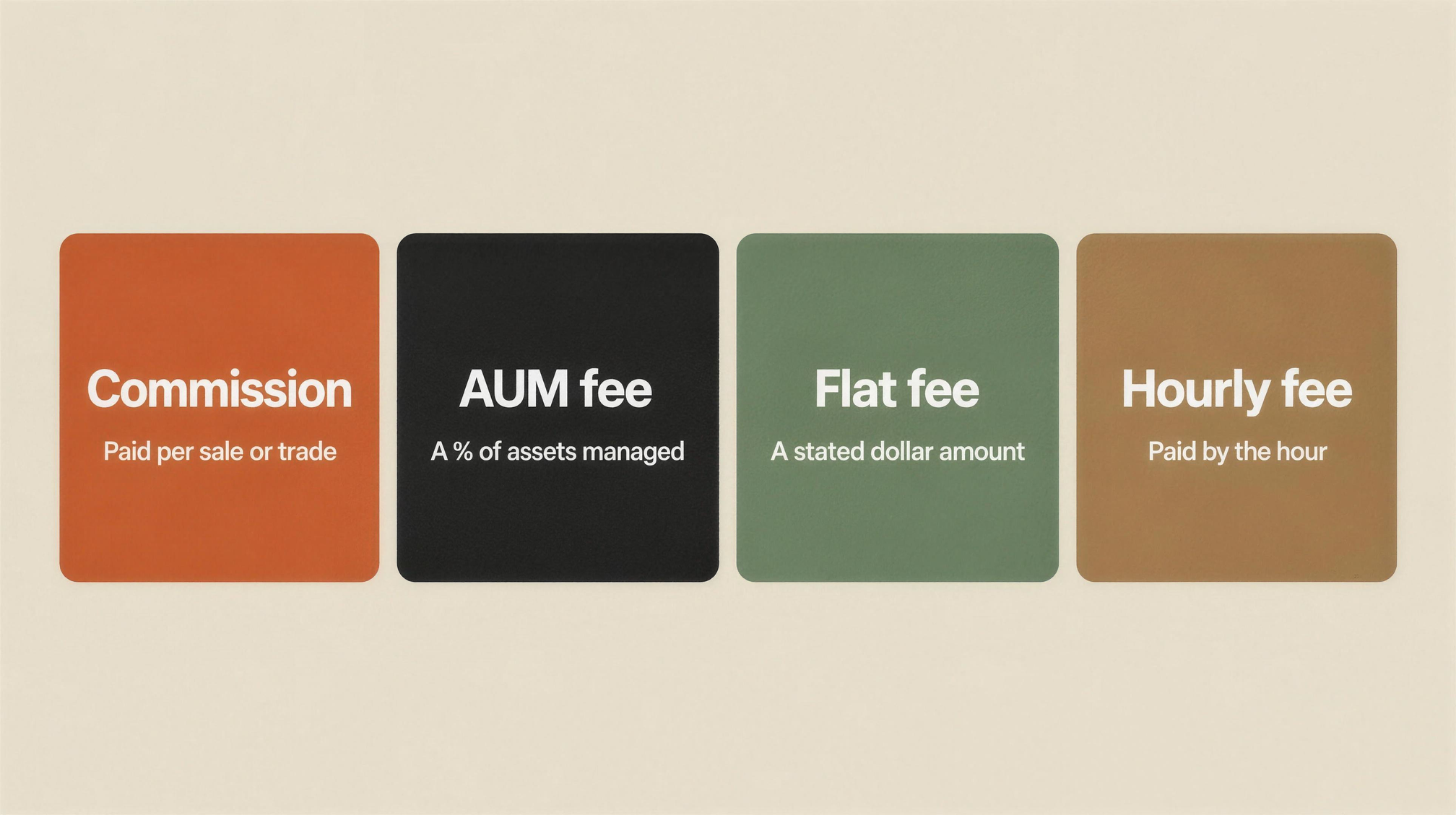
The research identifies work that may have value. The price and scope of your particular engagement still need to make sense. Financial professionals commonly charge through four models, and some combine them.
| Model | How you pay | What to examine |
|---|---|---|
| Commissions | Compensation from a transaction or product sale, which may be built into the product's cost. | Product incentives, total costs, and whether ongoing service is included. |
| Assets under management (AUM) | A percentage of the assets the advisor manages. | The dollar fee, any tiers, the services included, and incentives tied to keeping assets under management. |
| Flat fee | A stated dollar amount for an engagement or period. | Scope, complexity adjustments, renewal terms, and charges for work outside the agreement. |
| Hourly | An hourly rate multiplied by the time spent. | Estimated hours, deliverables, and responsibility for implementing the recommendations. |
Fee-only describes the source of compensation. It doesn't tell you whether the advisor charges an AUM fee, a flat fee, or by the hour. A fee-based advisor charges fees and can also earn commissions or other sales-related compensation, which a fee-only advisor can't. Valence Wealth charges a flat fee, so we have a commercial interest in this comparison. No billing method establishes the quality of the work by itself.
Our guide to how financial advisors get paid explains the four models and their incentives in more detail. You can also watch What Is Your Financial Advisor REALLY Costing You? in our Video Library, which walks through the costs and questions to ask.
Before hiring an advisor, ask for the annual cost in dollars, a written description of the work included, and a clear division of responsibility for carrying it out. Compare that engagement with managing the work yourself or paying for a focused project. The advisor still needs to show how the proposed work fits your financial decisions.
Disclosures: The information provided is for educational and informational purposes only and does not constitute investment, tax, or legal advice and should not be relied on as such. It is not a solicitation to buy or an offer to sell any security. It does not take into account any individual's particular investment objectives, financial situation, or needs. You should consult your own financial advisor, tax advisor, or attorney before acting on any information herein. All investing involves risk, including the possible loss of principal. Figures and tax limits referenced are for the applicable tax year and are subject to change. Valence Wealth, LLC is a registered investment advisor in the State of Arizona. Registration does not imply any specific level of skill or training.
Sources
- Celebrating Vanguard Advisor's Alpha: Clients and their advisors thriving together for 25 years, 2025, Figure 2 and notes on page 3 and intermittent opportunities on page 4Vanguard
- Value of an Advisor in 2026: Insights from Russell Investments' 13-Year Study, May 5, 2026, summarizing the 2026 Value of an Advisor Study (13th edition), with figures on pages 2, 5, 8, 10, 11 and 13 of the full study. The full study is for financial professional use only and is not linkedRussell Investments
- Capital Sigma: The Advisor Advantage, 2019 (ENV-WP-CS-0119), executive summary and Table 1 on pages 2 and 3. Earlier edition: Capital Sigma: The Return on Advice, May 2016, as described in Envestnet Launches The Essential Advisor, May 18, 2016, section "Crossing the Digital Divide by Delivering a Return on Advice"Envestnet
- Alpha, Beta, and Now...Gamma, August 28, 2013, David Blanchett and Paul Kaplan, abstract on page 2, Figure 1 on page 14 and cost caveat on page 16Morningstar Investment Management
- The emotional and time value of advice, June 2025, Paulo Costa and colleagues, summary on page 1, method on page 2, selection caveat on page 4, peace of mind on page 5 and time savings on page 8Vanguard