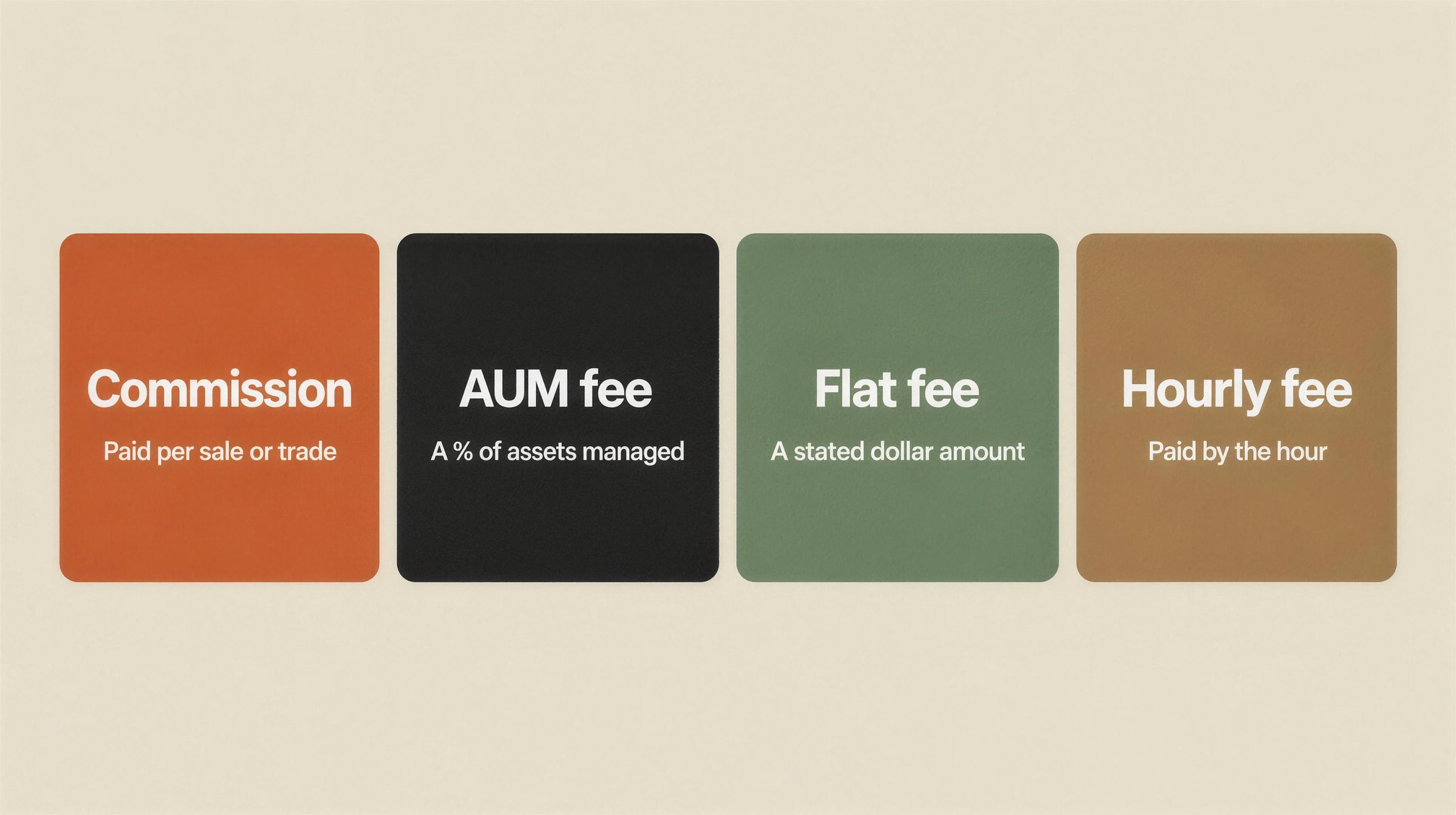
Financial advisors are paid through a handful of common pricing structures: commissions, asset-based fees, flat or subscription fees, hourly fees, or combinations of these. Two other terms, fee-only and fee-based, describe where the compensation comes from rather than how the bill is calculated.
The four pricing structures:
- Commission. The advisor is paid when a transaction or product sale happens.
- Asset-based, usually called AUM. A stated percentage of the assets the advisor manages for you.
- Flat or subscription fee. A stated dollar amount, billed annually, quarterly, or monthly.
- Hourly. A stated rate for the time spent on your questions.
Each structure can be legitimate. Each also creates different incentives, which is why it's worth knowing which one you're paying.
Prefer to watch? This 7-minute video covers all four models and the 3 questions to ask. The full transcript is on the video page.
How do commissions work?
A commission-based professional is paid when a transaction or product sale occurs. Depending on the product, you may pay the commission directly, through a sales load, or indirectly through a markup, spread, or compensation built into the product.
You may never write a check, because the compensation comes out of the product's pricing. Which is exactly why it can feel free. FINRA's plain-language overview of fees and commissions is a good primer on what these charges look like in practice.
Commissions have a legitimate use case. If you want one transaction, a single bond purchase, a term life policy, one block of stock, paying once for that transaction can cost less than signing up for an ongoing fee you'll pay every year afterward.
The incentive to watch: a commission-based salesperson is paid to transact, and some products pay more than others. Under Regulation Best Interest, brokers must act in your best interest at the time of each recommendation and disclose their conflicts. That's a real standard.
It's also a different standard from the one an investment adviser owes, and the difference is worth stating precisely. Regulation Best Interest generally applies when a broker makes a recommendation. It doesn't by itself create an ongoing duty to monitor your account, which the SEC stated directly in the Regulation Best Interest adopting release. An investment adviser's fiduciary duty generally continues throughout the advisory relationship, within the scope of services the adviser agreed to provide, per the SEC's interpretation of the adviser standard of conduct and the Advisers Act antifraud provision at 15 U.S.C. 80b-6.
So a commission-based salesperson is generally not acting as your ongoing fiduciary. Once the product is sold, the obligations attached to that sale largely end. A broker can separately agree to monitor your account, and if they do, the SEC's position is that recommendations coming out of that monitoring are themselves covered by Regulation Best Interest. The practical question is whether anyone agreed to keep watching, in writing.
How does an AUM fee turn into dollars?
An AUM fee is a stated percentage of the assets your advisor manages for you, typically billed quarterly and deducted straight from the account, so the dollar cost rises and falls with the account value. As FINRA explains in its comparison of brokerage and advisory accounts, advisory fees are charged whether or not you buy or sell anything that quarter.
AUM pricing commonly runs on a tiered schedule that declines as assets rise, so any single percentage is a simplification of how the bill actually gets calculated. Every AUM illustration in this article uses 75 basis points (0.75%) as a stated assumption, and the assumptions behind my fee comparisons are published in the fee comparison methodology.
Run the math in round numbers, on a hypothetical: at an assumed flat 0.75% annual rate with no breakpoints and a steady account value, a $2,000,000 portfolio pays $15,000 a year, about $3,750 a quarter. A tiered schedule with breakpoints at that balance could bill less, and market movement changes the figure each quarter.
In my experience, the dollar figure is what surprises people. 0.75% sounds like a rounding error. $15,000 sounds like a used car, purchased annually. Both describe the same fee, and because it's deducted from the account rather than invoiced, many clients never see it written as a dollar amount at all. You can run your own balance and rate through the fee comparison calculator.
The AUM structure has real advantages. The fee usually bundles investment management, rebalancing, and planning into one price, with no meter running when you call. And the alignment is partly real: when your portfolio falls, the advisor's revenue falls with it.
The incentive to watch: the fee is tied to the assets in the account. Advice that moves money out, paying off the mortgage, gifting to kids, buying the rental property, leaving the 401(k) where it sits, reduces the advisor's revenue. Plenty of AUM advisors give that advice anyway. The structure just means the recommendation and the paycheck point in opposite directions, and you should know that going in.
The same tension shows up across planning work that never touches the managed account at all, like the timing of an 83(b) election on restricted stock or a year of Arizona state tax credits. None of it changes the account balance the fee is calculated on. Many AUM firms include that planning in the bundled fee regardless, which is worth confirming in writing before you sign.
How does a flat or subscription fee work?
A flat-fee advisor charges a stated dollar amount rather than calculating the fee directly as a percentage of assets. The amount can still vary with complexity, the services included, or a household's circumstances. Billed monthly or quarterly instead of annually, the same structure is often called a subscription or a retainer.
Full disclosure: Valence Wealth charges a flat fee (the schedule is public), so read this section knowing where I sit.
The appeal is that the price is decoupled from where your money lives. Advice about the 401(k), the mortgage, and the house carries the same price as advice about the brokerage account. The fee is also visible: an invoice, in dollars, instead of a quarterly percentage draw.
Whatever the billing cycle, the number is written down. Form ADV Part 2A requires a registered adviser to describe how it's compensated, provide its fee schedule, and state how often it bills, so the dollar figure and the billing cycle both sit in the firm's brochure.
Flat fees carry their own honest trade-offs, and the arithmetic can run against you on a smaller portfolio. Here's another rounded hypothetical for illustration only: $12,000 flat fee on a $600,000 portfolio is 2% of assets, while the same $600,000 billed at the 0.75% rate used above would run $4,500. The flat fee costs $7,500 more that year. And a flat-fee advisor is paid the same whether they meet you quarterly or lose your file, so ask exactly what the fee includes and how often you'll actually talk. (Mine is listed service by service.)
How does an hourly fee work?
An hourly advisor bills a stated rate for the time spent on your questions, like an attorney or a CPA, and you keep responsibility for implementing whatever you decide. The rate appears in the firm's Form ADV brochure alongside how the firm bills for it.
Hourly advice suits narrow, well-defined questions: a second opinion on a rollover, a one-time plan review, a single equity compensation decision like what to do with shares delivered at an RSU vest.
The trade-off is behavioral. When every call has a meter on it, you hesitate to call, and the question you sat on in March can cost real money by December. The incentive to watch is the meter itself: revenue scales with hours billed.
What do fee-only and fee-based mean?
These two terms classify the source of an advisor's compensation. Fee-only means the client is the advisor's only source of pay. Fee-based means advisory fees plus the ability to earn commissions or other sales-related compensation. Either label can sit on top of AUM, flat, or hourly pricing underneath.
These two terms are one syllable apart, and in my experience they're the pair people mix up most.
Under a fee-only structure, your advisor is compensated by you, and only you: no commissions, trails, or other sales-related compensation from product providers. NAPFA's definition requires that neither the advisor nor any related party receive compensation contingent on the purchase or sale of a financial product. CFP Board draws the same line in its guidance on describing compensation: a CFP® professional can call themselves fee-only when they, their firm, and related parties receive no sales-related compensation.
Fee-based means fees plus. A fee-based advisor typically charges advisory fees and can also earn commissions, often through dual registration as both an investment adviser representative and a broker or insurance agent. The same person can wear two hats, sometimes in the same meeting.
Fee-based has its own genuine advantage: one relationship can cover both advice and implementation. If your plan calls for insurance, a fee-based advisor can place the policy instead of handing you a referral. The disclosure documents will spell out how they're paid for each piece.
What the structure asks of you is attention. When a fee-based advisor recommends a product, you need to know which hat is on. The Form CRS relationship summary that SEC-registered firms give retail investors states whether the firm earns commissions, and it runs 2 to 4 pages. Read it before the second meeting.
How the bill is calculated
| Structure | How it works | Typical cost, per cited sources | Incentive to watch |
|---|---|---|---|
| Commission | Paid when a transaction or product sale occurs, directly or through a load, markup, spread, or compensation built into the product | Varies by product; disclosed in trade confirmations, prospectuses, and Form CRS | Paid to transact; some products pay more than others |
| AUM | Percentage of managed assets, billed quarterly from the account (FINRA) | A stated percentage of account value; this article assumes 0.75% per year, and real schedules are commonly tiered and decline as assets rise | Fee tied to assets in the account; advice that moves money out cuts revenue |
| Flat or subscription | A stated dollar amount rather than a percentage of assets, billed annually, quarterly, or monthly | A stated dollar figure, published in the adviser's Form ADV | Can be a high percentage on smaller accounts; ask what the fee includes |
| Hourly | Billed per hour of advice, like an attorney or CPA | A stated hourly rate, published in the adviser's Form ADV | Revenue scales with hours; the meter can discourage you from calling |
How the compensation is classified
| Label | What it means |
|---|---|
| Fee-only | No commissions, trails, or other sales-related compensation from product providers. The client is the only payer (NAPFA, CFP Board) |
| Fee-based | Advisory fees plus the ability to receive commissions or other sales-related compensation, often through dual registration |
What should you ask before you sign?
Ask any advisor 4 questions before you sign: how they get paid and what that came to in dollars last year, whether anyone besides you pays them, what the fee includes, and when they act as a fiduciary. The SEC's investor education site keeps a page on understanding fees that runs the effect of fees in dollars on a hypothetical $100,000 investment. Borrow that frame and get your own answer in dollars.
- How do you get paid, and what would I have paid last year, in dollars?
- Do you or any related party earn commissions or other compensation from anyone besides me?
- What exactly does the fee include, and what costs extra?
- When are you acting as a fiduciary, and does that duty cover all of the advice you provide me?
Any advisor should be able to answer all four clearly. Long pauses are data.
Common questions
What's the difference between fee-based and fee-only?
Fee-only advisors are paid by their clients alone and can accept no commissions or other sales-related compensation, per the NAPFA and CFP Board definitions. Fee-based advisors charge fees and can also earn commissions on products they sell. The terms sound interchangeable, and the structures behave differently, so ask directly: "Can you or your firm earn commissions?"
How much does a financial advisor cost per year?
The annual cost depends on the pricing structure: as a labeled hypothetical assuming a flat 0.75% rate with no breakpoints, a 0.75% AUM fee on $2,000,000 is $15,000 a year, while a flat-fee firm charges its stated annual amount and an hourly planner bills the hours you use. Commission costs depend on what you buy. AUM schedules are commonly tiered and decline as assets rise, so a real bill can differ. A registered adviser's actual fee schedule is in its Form ADV Part 2 brochure, which is public, and you can compare it against a flat fee in the fee calculator.
How do I find out how a specific advisor is paid?
Look them up in the SEC's Investment Adviser Public Disclosure search, which shows registrations, disciplinary history, and the firm's Form ADV. Then read the firm's disclosure brochure, plus the Form CRS if the firm is SEC-registered, which states in plain language how the firm earns money and what conflicts that creates. If the person is a broker or dually registered, FINRA's BrokerCheck covers that side of the record.