Amazon pays a big share of total compensation in restricted stock units, and the company's own annual report describes equity that vests over a service term of generally two to five years. That makes two months on the calendar, May and November, home to some of the most financially important paydays of the year for many Amazon employees. Here's how the grants vest, how they're taxed, why the default tax withholding often falls short, and what to think about once the shares are yours.
How does Amazon's RSU vesting schedule work?
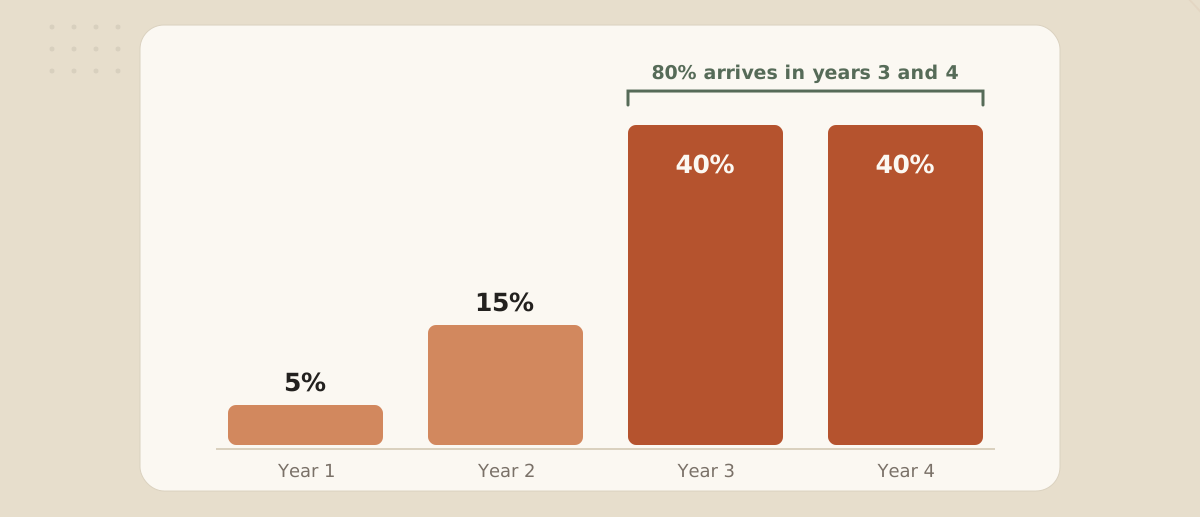
Amazon's new-hire grants are famously back-loaded. The commonly used four-year schedule vests 5% in year one, 15% in year two, then 40% in each of years three and four - not the even 25% per year many large tech companies use. On a hypothetical $400,000 grant, roughly $20,000 of value would vest in your first year and $160,000 in your fourth, assuming an unchanged share price.
Vest dates follow a set calendar, and that calendar changed recently. Grants issued before a change reported in 2024 generally vest semiannually, in May and November. Newer grants generally vest quarterly - in recent cycles, February, May, August, and November. Amazon's own annual reports track the shift - the filing covering 2024 describes RSUs that primarily vest semiannually, while the filing covering 2025 says they primarily vest quarterly. Many employees may hold both kinds of grants at once, so both calendars can apply until the older grants finish, and your individual grant agreements control your exact dates. For employees holding pre-change grants, May and November may still carry much of the value, which is why those two months dominate planning conversations.
Two features smooth out the back-loading. Amazon has commonly used sign-on bonuses covering the first two years, with the year-one installment typically larger. These are cash, often paid in installments through payroll rather than as a lump sum, on top of your base salary, sized so your total compensation stays near target while the equity vesting is still small. And employees may receive refresh grants at review time that layer new multi-year vesting schedules on top of the original one - refresh grants tend to be back-loaded too, often starting to vest about two years out. A few years in, many tenured employees have several overlapping grants, and the vest amounts start arriving in larger, steadier waves.
How are Amazon RSUs taxed?
RSUs are taxed as ordinary income when they vest, not when they're granted. On each vest date, the market value of the shares that vest is added to your W-2 wages, exactly like a cash bonus paid in stock. If 100 shares vest at $250, that's $25,000 of wage income, whether or not you sell a single share.
From that moment on, the shares behave like any stock you bought at the vest-date price. Your cost basis is the market value at vest. Sell later for more and the gain above basis is a capital gain - short-term if you held the shares a year or less, long-term if you held them longer. Sell at vest and there's typically little additional capital gain or loss.
Why the default withholding often falls short
Here's the part that surprises people at their first big vest. RSU income is a supplemental wage, and the IRS default withholding rate on supplemental wages is a flat 22% (37% only on amounts above $1 million in a calendar year). But the back-loaded schedule means years three and four can push total income well into the 32% to 37% federal brackets. If your marginal rate on those additional dollars is 32%, 35%, or 37%, the 22% default may not cover the tax - and the shortfall can produce a balance due the following April and, absent a safe harbor or other exception, an underpayment penalty. Our guide to safe harbor estimated taxes walks through how to size that gap and cover it without penalties.
A worked example, fully hypothetical: an employee has 320 shares vest in November at a $250 share price. That's $80,000 of ordinary income, and federal withholding at 22% sets aside $17,600. Assume those dollars land in the 32% bracket - the federal tax on them is roughly $25,600, leaving an $8,000 gap on this vest alone. Your actual bill is determined by your total annual income, not each vest in isolation, but multiply a gap like that across several vests a year and the shortfall can quietly reach a painful number. Our RSU tax gap calculator runs this estimate on your own numbers in about a minute.
Could you take part of a vest as cash?
Amazon has offered some eligible employees an optional election to receive 25% of certain future RSU value as cash, with the remainder delivered as shares. Public reporting described the program in 2024. Under the reported structure, the cash amount is set using a pre-determined planning price rather than the market price on each vest date.
This is different from selling shares after they vest - it's a forward-looking compensation election. You're trading some future Amazon stock exposure for more certain cash. If the stock later trades above the planning price, you gave up upside on the converted portion. If it trades below, the election reduced your downside on the converted portion.
The option has been described publicly as limited and elective, with eligibility and enrollment details that vary by compensation cycle. Check your current Amazon compensation materials and enrollment deadlines before assuming it applies to you. And the cash portion is wage compensation subject to withholding, not capital gain.
A practical way to think about it - if Amazon offered you cash at its planning price for a quarter of next year's scheduled RSUs, would you rather have the cash or keep the full stock exposure? The honest answer depends on your liquidity needs, your withholding gap, your existing concentration, and how much volatility you're willing to hold.
What should you do with vested shares?
Once shares vest, holding them is a choice, not a default. The question to ask: if this vest had arrived as cash, would you buy Amazon stock with it today? For some people the answer is yes, in a sized, deliberate way. For many, the honest answer is that they'd diversify.
The case for selling some or all at vest is about concentration, not conviction. Your paycheck, your future refresh grants, and your unvested schedule already depend on the same company. Stacking vested shares on top concentrates that further, and concentrated positions carry the risk of significant loss. Selling at or near vest also has a modest tax cost, since basis equals the vest-date price.
For long-tenured employees sitting on shares with large embedded gains, selling everything at once can mean a substantial tax bill. There are middle paths - staged selling over several years, harvesting losses elsewhere in the portfolio, gifting strategies, and for larger positions, exchange funds that diversify without an immediate sale, where available and suitable. Each has real trade-offs, and the right mix depends on your numbers.
Common questions
When do Amazon RSUs vest?
New-hire grants commonly vest over four years: 5% in year one, 15% in year two, and 40% in each of years three and four. Grants issued since the change reported in 2024 generally vest quarterly - in recent cycles, February, May, August, and November. Older grants generally vest in May and November until they finish, and your grant agreement controls your exact dates.
Did Amazon change its RSU vesting schedule?
Yes. Starting with the 2024 compensation cycle, Amazon moved new RSU grants from semiannual vesting (May and November) to quarterly vesting for many corporate employees - Amazon's most recent annual report describes RSUs that now primarily vest quarterly. Grants issued before the change keep their original May and November calendar, so many employees are living on both schedules at once.
How much tax is withheld when Amazon RSUs vest?
Federal withholding on RSU income generally follows the IRS supplemental wage rate - a flat 22%, or 37% on supplemental wages above $1 million in a calendar year. State withholding applies on top. If your marginal federal bracket is above 22%, the default withholding alone may not cover the tax.
Do I pay taxes twice on RSUs?
No. You pay ordinary income tax once, on the value at vest. After that, only the growth above your vest-date basis is taxed, as a capital gain when you sell. Double taxation usually enters the conversation at filing time - the basis a broker reports on RSU shares may not reflect the vest-date value in some cases, and using an unadjusted number would tax the vest value a second time. Worth a careful look every filing season.
What happens to my unvested RSUs if I leave Amazon?
Unvested RSUs are generally forfeited when you leave, though your grant agreement and plan documents govern and can carve out exceptions. That's the design of a back-loaded schedule - the largest vests sit in years three and four. Anyone weighing an offer elsewhere should price the unvested value they'd walk away from, and anyone negotiating a new role can ask the next employer to buy some of it out.
Plan around the vest calendar, not after it
Before a vest lands - estimate the income, check the withholding gap, and decide what you'll do with the shares. If you'd like help building that plan around your own vest schedule, tell us a little about your situation and we'll set up some time to talk.
Disclosures: Valence Wealth is an investment adviser registered in the State of Arizona. Valence Wealth is not affiliated with, endorsed by, or compensated by Amazon.com, Inc., and Amazon has not reviewed or approved this content.
The information provided is for educational and informational purposes only and does not constitute investment, tax, or legal advice and should not be relied on as such. It is not a solicitation to buy or an offer to sell any security. It does not take into account any individual's particular investment objectives, financial situation, or needs. You should consult your own financial advisor, tax advisor, or attorney before acting on any information herein. All investing involves risk, including the possible loss of principal. Figures and tax limits referenced are for the applicable tax year and are subject to change. Valence Wealth, LLC is a registered investment advisor in the State of Arizona. Registration does not imply any specific level of skill or training.
Compensation program features described reflect publicly available information as of the date of publication. Amazon can change its programs at any time, and your grant agreement and plan documents govern.
Sources
- Amazon.com, Inc. Form 10-K, year ended December 31, 2025 (stock-based compensation; RSU vesting terms)U.S. Securities and Exchange Commission
- Levels.fyi: Amazon compensation structure (5/15/40/40 vesting; sign-on bonus timing)Levels.fyi
- AdvisorFinder: Amazon stock compensation guide (compensation structure; refresh grants; 25% cash election mechanics)AdvisorFinder
- Fortune: Amazon shifts L6-L7 RSU vesting to quarterly (March 2024)Fortune
- The Information: Amazon lets employees swap stock grants for cash (April 2024)The Information
- Amazon.com, Inc. Form 10-K, year ended December 31, 2024 (semiannual vesting language, for the schedule change)U.S. Securities and Exchange Commission
- IRS Publication 15: supplemental wage withholding ratesInternal Revenue Service
- IRS Publication 525: taxable and nontaxable income (restricted stock units)Internal Revenue Service
- IRS Topic 409: capital gains and lossesInternal Revenue Service