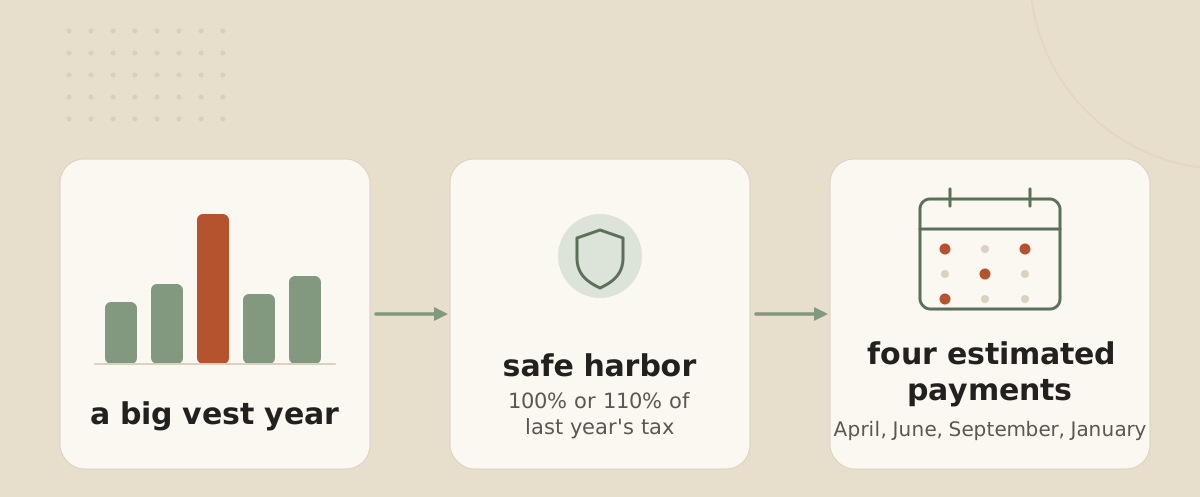
To avoid a federal underpayment penalty in a big RSU year, you generally need your withholding and estimated payments to reach one of two safe harbors:
- 90% of this year's total tax, or
- 100% of last year's tax, which becomes 110% if your prior-year AGI was over $150,000.
Reach either number and the penalty generally goes away, no matter how much you still owe in April. And in a vest year, the prior-year number is usually the one to aim at, because you already know it.
None of this requires a market view or a forecast. You are hitting a number you can already calculate, on dates that are already set. Fix the target in March and the rest of the year takes care of itself.
| Rule | 2026 federal threshold |
|---|---|
| Current-year safe harbor | 90% of current-year tax |
| Prior-year safe harbor | 100% of prior-year tax |
| Higher-income prior-year safe harbor | 110% if prior-year AGI was over $150,000 |
| Small balance exception | Generally under $1,000 due after withholding |
| Late-year fix | Withholding can generally receive even-quarter treatment; estimated payments cannot retroactively erase earlier underpayments |
Why does a big vest year create an underpayment problem?
A big vest year creates an underpayment problem because employer withholding on RSU income, often set at a flat supplemental-wage rate, can land well below the marginal rate that actually applies, leaving your pay-as-you-go payments short of what the year requires.
RSU income is generally taxed as ordinary wages when shares vest. Your employer withholds on it, so it feels handled. Often it isn't, and here's why.
Many employers withhold federal income tax on RSU income at the flat 22% supplemental-wage rate set out in IRS Publication 15. That rate is one permitted method, and it applies through $1 million of supplemental wages; amounts above $1 million are subject to mandatory 37% withholding on the excess. If all or most of your vest income lands in the 32%, 35%, or 37% brackets, which depends on your full tax picture, withholding at 22% can run 10 to 15 percentage points short on every vested dollar. The RSU Tax Gap Calculator estimates that gap from your salary, vest value, and filing status.
On a $700,000 vest year, if that income lands in the top brackets, the shortfall can approach six figures. The same gap shows up vest by vest in the walkthrough of Axon RSU vesting and withholding.
The IRS doesn't wait until April to care. Federal income tax is pay-as-you-go, and if your payments fall too far behind during the year, an underpayment-of-estimated-tax penalty can apply on top of the balance due, computed on Form 2210.
What are the two safe harbors?
The two federal safe harbors, set out in IRC section 6654, are 90% of the current year's tax and 100% of the prior year's tax, which becomes 110% when prior-year AGI was over $150,000; reaching the smaller of the two generally avoids the underpayment penalty.
In general terms, you avoid the penalty for a year if your total withholding plus timely estimated payments reach the smaller of:
- 90% of the current year's tax. Precise, but it requires projecting a moving target while shares are still vesting.
- 100% of the prior year's tax, which becomes 110% if your prior-year adjusted gross income was more than $150,000 ($75,000 if married filing separately), a threshold the IRS spells out on its underpayment of estimated tax by individuals penalty page.
There's also a floor: if your balance due after withholding is under $1,000, no penalty generally applies, under the de minimis exception in IRC section 6654(e). In a vest year, you generally won't be under it.
The prior-year harbor is the workhorse. Your prior-year tax is a fixed number sitting on last year's return (total tax, not the refund line). Multiply it by 110% and you have a target that cannot move on you, no matter what the stock does. Pay that much, evenly and on time, and the penalty question is generally closed even if your actual bill lands far higher.
Those are the main branches. The rules have more of them, like annualizing uneven income on Form 2210 and waivers in limited cases. IRS Publication 505 is the full map, and a tax professional can tell you which branch you're standing on.
Why late-year withholding can be more flexible than estimated payments
Withholding beats estimated payments on timing, because tax withheld from wages is generally treated as paid evenly across all four quarters no matter when it came out of your pay, while an estimated payment counts only from the date you make it.
This is the timing quirk, and it's the most useful fact in the piece.
Estimated payments are credited when you make them. Miss the first-quarter deadline and a payment in September can't repair it; the penalty accrues on that quarter's shortfall from its due date forward.
Withholding is different. Dollars withheld in December count as if a quarter of them were paid back in April, which is the default treatment described in the Form 2210 instructions.
So if you discover in October that you're short for the year, a withholding bump can cure a shortfall that began in February. Options people commonly use: filing a new Form W-4 with a dollar amount on Line 4(c), Extra withholding, for the remaining pay periods, or, where the stock plan allows it, electing a supplemental withholding rate above 22% on a year-end vest. Which fits your situation is a conversation for your tax professional. (Form 2210 also lets you elect the actual withholding dates instead, for the rare case where that's better.)
The year-end withholding bump is often the more practical route, because it requires one form before payroll's cutoff instead of four separate deadlines.
A big vest year, in round numbers
Here's a rounded hypothetical for illustration only. A married couple filing jointly had a strong prior year: total federal tax of $250,000, AGI well over $150,000. This year, one spouse earns a $300,000 salary and vests $700,000 of RSUs. The employer withholds at the flat 22% supplemental rate.
| Line | Amount |
|---|---|
| Prior-year total tax | $250,000 |
| Safe harbor target (110%, AGI over $150,000) | $275,000 |
| RSU income vesting this year | $700,000 |
| Withholding on RSU vests at 22% | $154,000 |
| Withholding on salary (illustrative) | $60,000 |
| Total projected withholding | $214,000 |
| Gap to the safe harbor | $61,000 |
The couple is $61,000 short of the number that shuts the penalty off. Close it with quarterly estimated payments, or close it with extra withholding at any point in the year, and the penalty issue generally goes away.
What doesn't go away is the April bill. Run it through the 2026 married-filing-jointly brackets and, on $1 million of wages with the standard deduction and nothing else unusual in the return, the federal income tax lands near $280,000. Your own figure moves with deductions, credits, and the rest of the return. That happens to sit close to their $275,000 prior-year safe harbor target, so on these simplified facts the April balance is small. In a real vest year, investment income, a larger grant, a bonus, deductions, credits, and state taxes can move that balance materially in either direction. The safe harbor limits the estimated-tax penalty; it does not cap the tax due. So the other half of the plumbing is parking the expected April balance in cash, someplace boring, until it's due.
Run the check in the other direction too: if last year was an ordinary income year and this is the outlier, your regular withholding plus 22% on the vests may already clear the 110% target on its own. Do the arithmetic, with the IRS Tax Withholding Estimator or your tax preparer, before writing estimated checks you don't need.
The quarterly calendar
Federal estimated payments are due in 4 installments, on April 15, June 15, September 15, and January 15 of the following year, filed with Form 1040-ES vouchers or paid electronically. For 2026 income:
- April 15, 2026 for income from January through March
- June 15, 2026 for April and May (yes, a 2-month period)
- September 15, 2026 for June through August
- January 15, 2027 for September through December
The periods are uneven, which trips people up: the second payment arrives 2 months after the first. Dates shift a day or two when they land on a weekend or holiday.
What does the penalty actually cost?
The penalty works like interest, computed quarter by quarter on each period's shortfall at the federal underpayment rate, which is the short-term rate plus 3 percentage points, adjusted quarterly. It is calculated daily using the applicable quarterly rate, without compounding: section 6622(b) excludes this penalty from the daily compounding that applies to interest generally.
As of the third quarter of 2026, the IRS underpayment interest rate is 7%, up from 6% in the second quarter.
A shortfall of that size, spread across the installment periods, could cost on the order of a couple thousand dollars at current rates. Form 2210 computes the penalty period by period, so the exact figure depends on when each shortfall arose. Survivable, but it's pure deadweight for skipping paperwork, and the couple in the hypothetical could delete it with one W-4 change.
Arizona wants its own payments
Arizona runs a parallel system: in general terms, you're required to make Arizona estimated payments on Form 140ES if your Arizona gross income was more than $75,000 in the prior year ($150,000 married filing jointly) and you expect to cross that line again this year.
The required annual payment follows a similar safe-harbor shape, generally the smaller of 90% of the current year's Arizona tax or 100% of the prior year's, and Arizona charges its own underpayment penalty when payments fall short. The state's rules and forms are at the Arizona Department of Revenue's individual estimated tax payments page. With Arizona's flat 2.5% rate the dollars are smaller than the federal side, but the deadlines are just as real.
Two Arizona wrinkles are worth checking before you size the payments. Arizona's dollar-for-dollar charitable and school tax credits can reduce the Arizona tax you're estimating against, and if you moved to Arizona holding unvested equity, part of a vest can still belong to your former state's return.
It's the kind of task that a flat-fee planning relationship handles as routine maintenance, alongside the vest-by-vest projections that feed it.
Valence Wealth is an investment adviser registered in the State of Arizona, and the flat fee is published up front.
Common questions
Which safe harbor should I use in a big vest year?
Generally the prior-year harbor: 110% of last year's total tax if your prior-year AGI was over $150,000, because it's a fixed, knowable number and usually far below what 90% of a spike year would require. If this year's income will be lower than last year's, the 90% current-year test can be the cheaper target instead, and the annualized income method on Form 2210 can help when income arrives late in the year.
Can I fix an underpayment in December?
Often, yes, through withholding: because withholding is generally treated as paid evenly across the year, extra withholding from late-year paychecks or vests can cure shortfalls from earlier quarters. A December estimated payment can't do that; it only counts from the date it's made.
If I meet the safe harbor, do I still owe money in April?
Very possibly, and in a big vest year, probably a lot: the safe harbor generally removes the underpayment penalty; it doesn't reduce the tax itself. Whatever your actual liability exceeds your payments is due at filing, so the difference generally needs to be held in cash until then.
Do I have to make Arizona estimated tax payments too?
Generally yes, if your Arizona gross income was more than $75,000 in the prior year ($150,000 married filing jointly) and you expect to cross that line again this year. Arizona uses Form 140ES, follows a similar safe-harbor shape under A.R.S. section 43-581 (generally the smaller of 90% of the current year's Arizona tax or 100% of the prior year's), and charges its own underpayment penalty. At the flat 2.5% rate the dollars are smaller than the federal side, but the deadlines are just as real.
How much does the underpayment penalty actually cost?
It works like interest rather than a flat fee. The IRS computes it quarter by quarter on each period's shortfall at the federal underpayment rate, which is the short-term rate plus 3 percentage points, adjusted quarterly. It is calculated daily using the applicable quarterly rate, without compounding: section 6622(b) excludes this penalty from the daily compounding that applies to interest generally. As of the third quarter of 2026 that rate is 7%. Because the calculation runs period by period on Form 2210 rather than on one annual balance, the cost depends on when each shortfall arose.
If you want a second set of eyes on your own safe harbor number before the next installment date, the Valence Wealth contact page is the place to start.