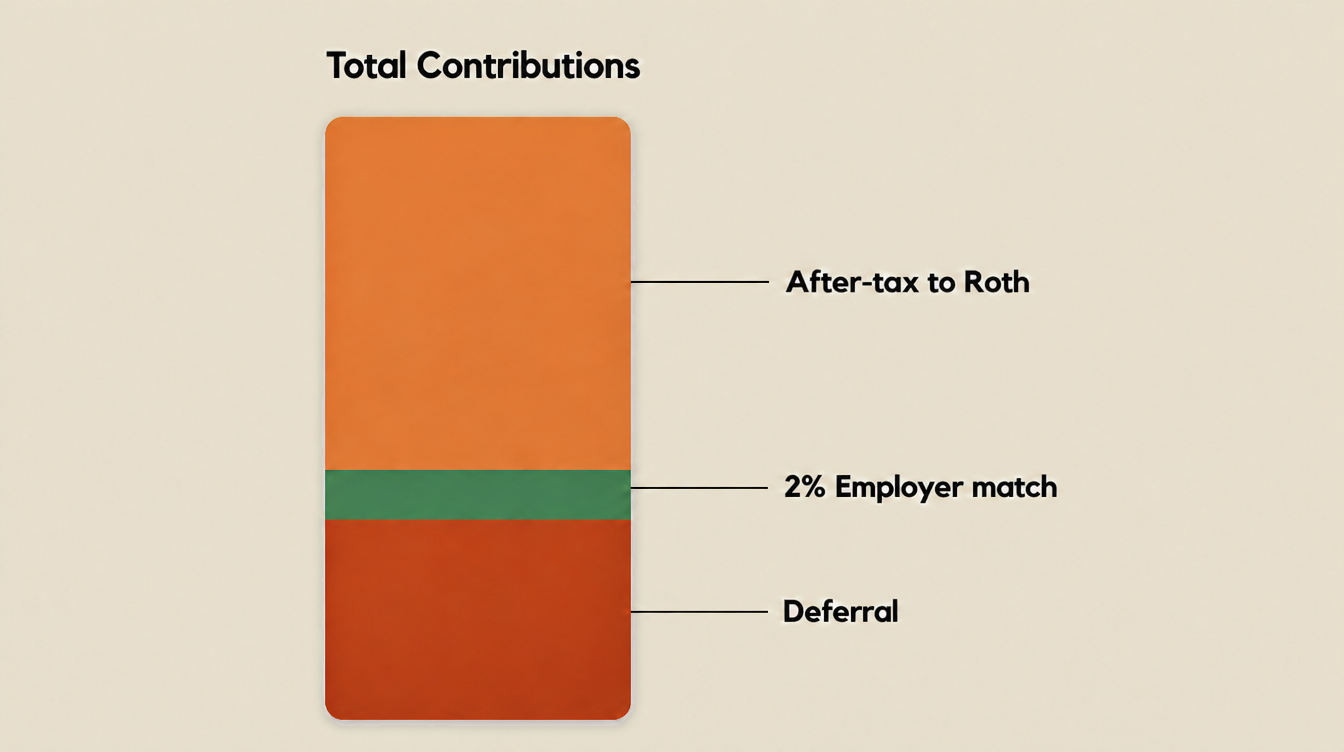
Axon competes for talent the way the rest of big tech does: strong salaries, meaningful equity, and a benefits package built to keep you. The equity side gets all the attention, and we've covered it in our breakdown of Axon RSUs and XSUs. But the quieter benefit, the 401(k), is where a few small elections quietly compound into real money over a career. Here are five steps to get everything out of it.
How does the Axon 401(k) work?
The plan is administered through Empower, enrolls you automatically, and accepts both pre-tax and Roth contributions in any split you choose. Per the plan's federal filings, Axon matches 100% of the first 3% of eligible compensation you defer, plus 50% of the next 2%, a safe harbor matching structure defined in the tax code, and the match is 100% vested immediately. The plan also permits discretionary profit-sharing contributions, which vest on a graded schedule tied to your years of service.
1. Capture the full match
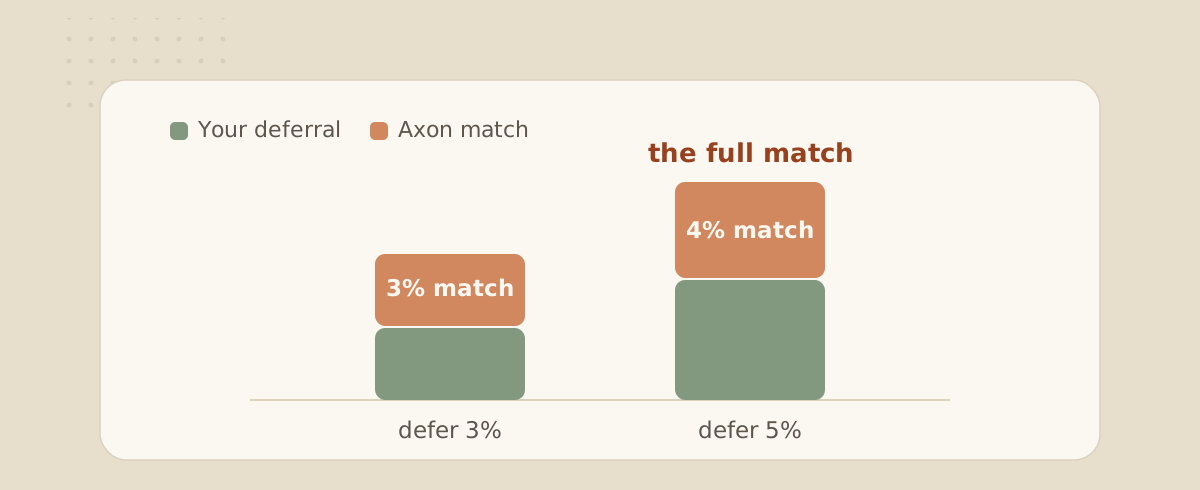
The match formula pays its maximum, 4% of your eligible compensation, once you defer 5%.
Stop at 3% and you collect only a 3% match.
In round numbers, on a hypothetical $200,000 of eligible compensation - a 5% deferral of $10,000 draws an $8,000 match. A 3% deferral draws $6,000. The difference, $2,000 every year, is compensation you either collect or leave behind, and it compounds for decades either way.
One habit worth building - spread your deferrals so a matched percentage comes out of every paycheck through December, rather than front-loading so hard that your deferrals stop mid-year. Matching happens payroll by payroll, and a paycheck with no deferral can be a paycheck with no match.
2. Maximize your deferrals
The match is the floor, not the ceiling. For 2026, you can defer up to $24,500 of your own pay, plus a catch-up of $8,000 beginning the year you turn 50, and up to $11,250 instead if you're 60 to 63 and the plan allows it.
One change that catches senior employees this year - under SECURE 2.0, your catch-up contributions must be made as Roth if your prior-year Axon wages topped $150,000. The regular $24,500 can stay pre-tax; the catch-up generally can't.
On a $200,000 salary, maxing the plan means deferring about 12.3% of pay. Pair that with the 4% match and roughly $32,500 a year is moving into tax-advantaged accounts - before you've invested a dollar anywhere else.
3. Choose pre-tax, Roth, or both
Pre-tax dollars skip today's taxes and get taxed at retirement on distribution. Roth dollars are taxed today, and contributions + growth, come out federal-tax-free once you've met the five-year and age-59½ requirements. Axon's plan lets you split between the two in any proportion, inside the same $24,500 limit.
The right split turns on your marginal tax rate today versus your expected rate in retirement. A big RSU vest can push you into the 32% to 37% brackets and tilt the math toward pre-tax. An early-career or deliberately light income year can tilt it toward Roth. Worth knowing on the Roth side - since 2024, Roth 401(k) accounts carry no lifetime required minimum distributions for the original owner. And for Arizona residents, our flat state tax keeps the federal analysis in the driver's seat.
4. Choose your own funds
As of March 2026, the lineup includes low-cost index funds covering the S&P 500, mid-caps, small-caps, and developed international markets, a target-date series, and a guaranteed fixed account.
The default target-date fund is a reasonable autopilot. But the index funds let you build a lower-cost, cleaner portfolio with three or four holdings.
One caution that matters more at Axon than almost anywhere else - your paycheck and your unvested RSUs and XSUs already ride on Axon's stock price. Your 401(k) is a place to build savings that do not, using the diversified funds above. Concentrated positions carry the risk of significant loss.
5. Revisit your elections every year
Compensation changes, brackets change, and the IRS limits move most years. A ten-minute annual review catches the common leaks - a deferral percentage that no longer reaches the new limit, a pre-tax and Roth split set in a different tax year, catch-up eligibility that arrived with a birthday, and contributions that stop before December and quietly cost match dollars. Vest windows are a natural trigger for the check, since a big equity year is exactly when the pre-tax versus Roth math shifts.
Common questions
How much does Axon match in its 401(k)?
Per the plan's federal filings, Axon matches 100% of the first 3% of eligible compensation you defer, plus 50% of the next 2%, for a maximum of 4% of your pay. Deferring at least 5% captures the full match, and it vests immediately.
Is the Axon match immediately vested?
Yes. The employer match is yours in full from day one, so a job change doesn't cost you employer dollars already contributed. Discretionary profit-sharing contributions vest on a graded schedule tied to service instead.
Do pre-tax and Roth contributions share one limit?
Yes. All your elective deferrals combined cap at $24,500 for 2026, plus any catch-up you're eligible for. There's no separate allowance for each type.
What happens to my 401(k) if I leave Axon?
Your contributions, your rollovers, and the vested match go with you. The destination decision deserves real care: leaving money in the plan can preserve institutional pricing and strong creditor protection, while rolling pre-tax dollars into a traditional IRA can create pro-rata complications for anyone using annual backdoor Roth IRA contributions. Which path fits you is a conversation for your tax professional, ideally before your last day.
If I change jobs mid-year, does my $24,500 limit reset?
No. The deferral limit is per person, per calendar year, across all employers. Payroll systems can't see what you deferred elsewhere, so tracking the combined total is on you.
Put the whole picture together
The 401(k) is one lever. At Axon it sits next to RSUs and XSUs, a vest calendar, and the withholding and estimated-tax questions that big equity years raise. The elections work best when they're set together rather than one at a time. If you'd like a second set of eyes on how yours fit, and clear flat-fee pricing, please tell us a little about your situation and we'll set up some time to talk.
Valence Wealth is an investment adviser registered in the State of Arizona. Valence Wealth is not affiliated with, endorsed by, or compensated by Axon Enterprise, Inc., Empower, or any fund company named above, and Axon has not reviewed or approved this content.
Disclosures: The information provided is for educational and informational purposes only and does not constitute investment, tax, or legal advice and should not be relied on as such. It is not a solicitation to buy or an offer to sell any security. It does not take into account any individual's particular investment objectives, financial situation, or needs. You should consult your own financial advisor, tax advisor, or attorney before acting on any information herein. All investing involves risk, including the possible loss of principal. Figures and tax limits referenced are for the applicable tax year and are subject to change. Plan features described reflect publicly available plan documents and filings as of the dates noted; plans can be amended at any time, and the plan's summary plan description and participant fee disclosure govern.
Sources
- 401(k) and profit-sharing plan contribution limits (2026)Internal Revenue Service
- Catch-up contributions (2026 amounts; $150,000 Roth catch-up rule)Internal Revenue Service
- Designated Roth accounts FAQInternal Revenue Service
- Required minimum distributions FAQInternal Revenue Service
- Cost-of-living adjustments for retirement limitsInternal Revenue Service
- 26 U.S.C. 401(k)(12): safe harbor matching formulasCornell Legal Information Institute
- Axon Enterprise Form 10-K, year ended December 31, 2025 (matching contribution totals)SEC EDGAR
- Axon 401(k) Plan Form 5500 filings (2024 plan year)DOL EFAST2