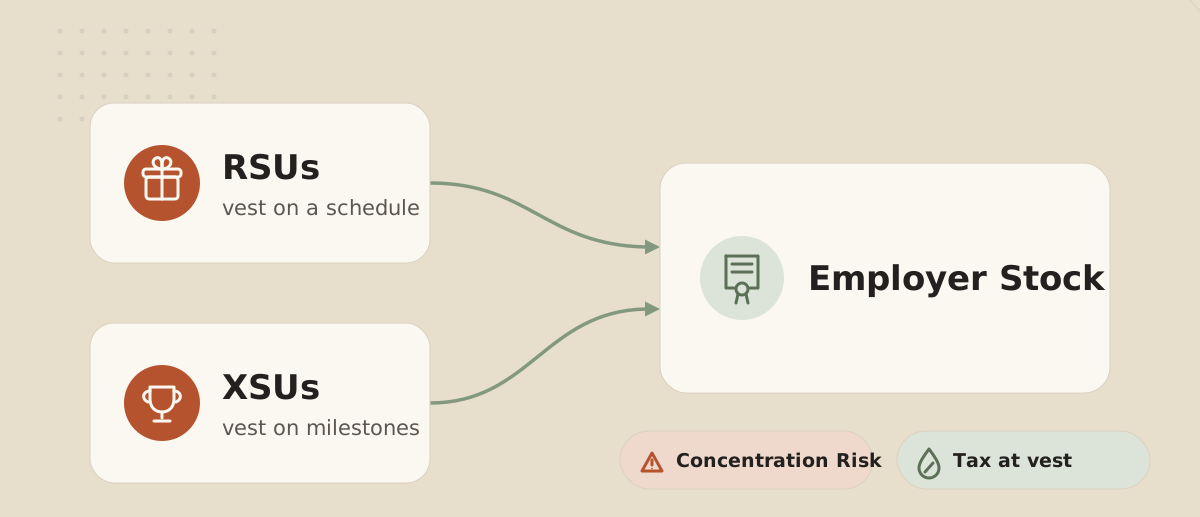
Work at Axon and a meaningful slice of your pay arrives as company stock rather than cash. That equity generally comes in two forms, and the difference between them drives most of the tax and planning questions on this page:
- RSUs: service-based grants that turn into shares on a preset schedule, taxed as ordinary income when they vest
- XSUs (eXponential stock units): performance-based grants that vest only when the Compensation Committee certifies a stock price goal, an operational goal, and a minimum service condition
Both generally produce ordinary income the moment shares are delivered, whether or not you sell anything. This page is a practical guide: what each piece is, when it generally gets taxed, and where the withholding math tends to fall short.
One thing stated plainly up front: Valence Wealth is not affiliated with, endorsed by, or compensated by Axon Enterprise. Our office sits a few miles from Axon's Scottsdale headquarters. This is education for the people who work there, built from public sources.
What's in a typical Axon equity package?
A typical Axon equity package is generally built from those two pieces: RSUs under the Amended and Restated 2022 Stock Incentive Plan, and XSUs under the Employee eXponential Stock Plan. Some roles also see performance-based RSUs and stock options under the same 2022 plan.
| Piece | General shape |
|---|---|
| RSUs | Service-based; grants commonly vest in equal annual installments over 3 years |
| XSUs | Performance-based stock units in 9 tranches; each tranche vests only when a stock price goal, an operational goal, and a minimum service condition are certified |
Your grant agreements control. Everything below is the general shape, and your documents can differ from it.
How are Axon RSUs taxed?
The taxable moment generally arrives when an RSU vests and settles in shares. The fair market value of the delivered shares counts as ordinary income on your W-2 in that year, whether you hold or sell. Your tax basis is generally established at the share price on the vest date.
A sale right after vesting generally produces little additional gain or loss, because the basis was established at the share price on the vesting date.
Withholding is where people run into tax issues. For separately identified supplemental wages, employers can withhold federal income tax at a flat 22% rate through $1 million in a calendar year; supplemental wages above $1 million are subject to mandatory 37% withholding on the excess (IRS Publication 15, as of 2026). Many employers use the flat 22% method on RSU income. The RSU Tax Gap Calculator estimates the gap between that withholding and tax at your bracket.
Those percentages apply to federal income-tax withholding. Social Security and Medicare withholding, plus applicable state withholding, are separate.
Here's a rounded hypothetical for illustration only: $150,000 of RSU income withheld at the flat 22% sends $33,000 to the IRS. If all or most of that income lands in the 32% or 35% marginal brackets, depending on your full tax picture, the real federal cost could be closer to $48,000 to $52,500. That's a gap of $15,000 or more that can surface at filing time, and depending on the shortfall, an underpayment-of-estimated-tax penalty can also apply. Quarterly estimates and the safe harbor thresholds are the usual tools for closing that gap before April, and I walked through them in how the safe harbor thresholds work for estimated taxes.
Some payroll and stock-plan systems allow employees to request additional withholding or otherwise increase total withholding. Whether Axon offers that option is a question for payroll or the stock plan administrator.
In my experience, withholding is where the surprises live, even for people who track their vesting schedule to the day.
Arizona adds a second layer. State withholding on wages runs off a percentage you elect on Form A-4, and the menu runs 0.5%, 1.0%, 1.5%, 2.0%, 2.5%, 3.0%, and 3.5% of gross taxable wages, with a 2.0% default applied when a new employee doesn't file the form within 5 days of hire (Arizona Department of Revenue, as of 2026). Arizona's income tax rate is a flat 2.5% for tax year 2023 and beyond, so an election below that can leave a state shortfall sitting on top of the federal one.
When do Axon RSUs actually vest?
There's no company-wide vest calendar at Axon. Each grant vests on its own schedule, measured from its own grant date, so two colleagues hired a few months apart can sit on completely different calendars.
One shape holds broadly. As a general rule under Axon's equity plan, an award may not vest in full before the 12-month anniversary of its grant date, subject to limited exceptions. Beyond that, the plan is explicitly written to facilitate awards with quarterly vesting schedules, annual-installment examples show up in Axon's public filings, and your grant agreement states which schedule yours follows.
Your grant agreement and your equity portal are the authority on your dates. Start there, and map the next 12 months: every vest date, the share count expected on each one, and which grant each tranche traces back to. That list is the input for most of the decisions further down this page.
The shape matters as much as the dates. An annual vest concentrates a full year of equity income into a single event, so any withholding shortfall arrives all at once and can make estimated-tax planning more important. If your grant is annual-shaped, sizing the gap early and running it against the safe harbor thresholds for estimated taxes generally beats finding it at filing time.
How do Axon XSUs work?
An XSU is a performance-based stock unit. It vests only after Axon's Compensation Committee certifies three conditions for its tranche:
- A stock price goal
- An operational goal
- A minimum service condition
The stock price goal is a sustained-price test. Under the plan's award agreement, a tranche's stock price goal counts as attained only when the volume-weighted average price of Axon stock over a consecutive 90-day period equals or exceeds the target. A single day's close above the number doesn't satisfy it. And once a goal is attained, a later slide in the average doesn't undo it.
The operational goal is stated as a revenue amount or an adjusted EBITDA amount for the trailing four quarters. Each tranche carries its own goals, and each tranche's goals carry a stated expiration date.
Expiration comes with a catch-up provision. A tranche that misses its own deadline can still be deemed satisfied if a later tranche's stock price and operational goals are achieved before that later tranche's expiration date. The grant agreement controls the exact mechanics, and it's also the authority on which tranches your units sit in.
The minimum service condition is the retention piece: each tranche has an earliest possible vest date, and you generally must still be employed at Axon when the tranche vests. Hitting the goals earlier doesn't accelerate a tranche past that date.
Put the three together and an XSU doesn't have a guaranteed vest date you can put on the calendar. Vesting waits on the goals being achieved and certified.
Shareholders approved the Employee eXponential Stock Plan on May 10, 2024, and the original grants were divided into seven substantially equal tranches. On January 23, 2026, the Compensation Committee approved two incremental tranches, Tranches 8 and 9, bringing the current plan to nine tranches. Whether Tranches 8 and 9 are part of your individual award depends on your grant. Certain operational goal amounts were adjusted in connection with acquisitions completed in the first quarter of 2026, so the numbers below reflect Axon's latest quarterly filing.
Three tranches have vested so far: Tranche 1 in June 2025, Tranche 2 in December 2025, and Tranche 3 in June 2026.
Here's how to read the table below. Each row is one slice of the XSU program. Rows marked vested have already paid out. The earliest possible vest date is the soonest a tranche can vest, and only if its goals are also certified. The stock price column is a 90-day volume-weighted average target rather than a single-day price, and the operational column is the revenue or adjusted EBITDA level required for the trailing four quarters, either of which satisfies that goal.
| Tranche | Status | Earliest possible vest date | 90-day VWAP stock price goal | Operational goal: revenue or adj. EBITDA (trailing 4 quarters) |
|---|---|---|---|---|
| 1 | Vested, June 2025 | June 2025 | $247.40 | Vested June 2025 |
| 2 | Vested, December 2025 | December 2025 | $309.25 | Vested December 2025 |
| 3 | Vested, June 2026 | June 2026 | $386.56 | Vested June 2026 |
| 4 | Unvested | December 2026 | $483.20 | $3.583B or $792M |
| 5 | Unvested | June 2027 | $604.00 | $4.479B or $1.035B |
| 6 | Unvested | December 2027 | $755.00 | $5.599B or $1.347B |
| 7 | Unvested | June 2028 | $943.75 | $6.999B or $1.697B |
| 8 | Unvested | December 2029 | $1,179.69 | $8.753B or $2.135B |
| 9 | Unvested | June 2031 | $1,474.61 | $10.940B or $2.681B |
How are Axon XSUs taxed?
Generally the way an RSU is taxed: the fair market value of the shares delivered when a tranche vests and settles is ordinary income on your W-2 in that year, whether you hold or sell. The difference is timing, because tranches settle on certification rather than on a calendar date.
Lumpy income is the planning problem. A tranche settling generally means a large slug of ordinary income landing in a single year, which makes the withholding math above bite harder and can push part of your supplemental wages past the $1 million line. If a tranche is certified in a year you weren't planning around, the estimated-tax question from the safe harbor walkthrough is the first one to answer, and if the vest is subject to the optional 22% flat supplemental-wage withholding rate, that rate may not cover the eventual federal tax liability.
One more wrinkle. For some XSU holders, shares from a vested tranche can't be sold right away; the holding requirement generally runs until the earlier of December 31, 2030 or the vesting of the next tranche. Taxes were generally still due at vest, which matters if you're counting on selling shares to cover the bill.
The elective side of the XSU plans
Axon has run 2 elective XSU programs, and they deserve separate ledgers.
The 2019 eXponential Stock Performance Plan came first. All eligible full-time U.S. employees received an automatic grant of 60 XSUs, and certain employees could elect to allocate a percentage of their target compensation over a nine-year period from 2019 to 2027 into additional XSUs. All 12 market capitalization and operational goals under that plan were achieved and certified as of December 31, 2023.
The 2024 Employee XSP is the current program, approved by shareholders on May 10, 2024. Participants could elect to receive a percentage of the value of their target compensation over a seven-year period from 2024 to 2030 in XSUs.
Electing XSUs reallocates part of a participant's target compensation into performance-based equity, increasing exposure to Axon's stock and operating results. XSUs generally pay nothing unless the applicable performance and service requirements are ultimately satisfied under the plan's vesting and catch-up mechanics. Your paycheck, unvested equity, and vested shares can all depend on the financial health of the same company. An election raises that exposure without adding a dollar of diversification, which is the general point the SEC makes in its investor material on asset allocation and diversification.
How concentrated is too concentrated?
No single percentage defines "too concentrated." One common way to frame it is the size of the impact on your financial security and your plan if the shares were to drop considerably.
Every piece above pays you in the same ticker. The position can grow quietly: annual RSU vests you never sold, a settled XSU tranche, an election that routed part of your pay into more units, all sitting next to a paycheck from the same company. Your 401(k) is a part of your Axon compensation where you choose the investments - our Axon 401(k) guide covers the match, the contribution limits and the fund menu.
Here's a rounded hypothetical for illustration only: a household with a $5,000,000 net worth holding $1,000,000 of AXON would see net worth fall by 10% if the stock dropped 50%. The question that matters is what that move would do to the goals the portfolio is funding: the retirement date, the college accounts, the mortgage payoff. Concentrated positions carry the risk of significant loss, and the loss case lands on a household that also depends on Axon for income.
The cleanest gut check I know: if Axon had paid you that $1,000,000 as cash, would you use all of it to buy AXON shares today? For some people, the honest answer is yes. For plenty of others, the position exists because selling never made it onto the calendar. Either way, holding is a decision, and unwinding a large position has tax costs of its own.
Six questions about your position
- How many unvested RSUs and XSUs do you hold, and what has to happen (dates, stock price goals, operational goals) for each one to vest?
- What was actually withheld on your last vest, and what will that income look like once it's sitting inside your full return?
- Does any of your stock carry a post-vest holding period, and until when?
- What percentage of your invested net worth is currently held in vested AXON shares?
- How much additional AXON exposure is represented by your unvested RSUs and XSUs?
- Have you ever elected to take compensation in XSUs, and how much guaranteed pay does that election cover?
If you'd like help building the answers, we'd be happy to schedule a complimentary introductory meeting. Our pricing is simple and transparent, and you can see how much our flat fee schedule could save you with the fee calculator, which states its assumptions up front.