The cruelest math in a concentrated stock position is that the better the stock did, the more expensive it is to diversify. A position with a huge embedded gain can cost up to 20% of the gain in federal taxes, and that’s before state taxes and the 3.8% net investment income tax (NIIT). Exchange funds exist for exactly this reason - they let you diversify a large, low-basis position without selling it.
What is an exchange fund?
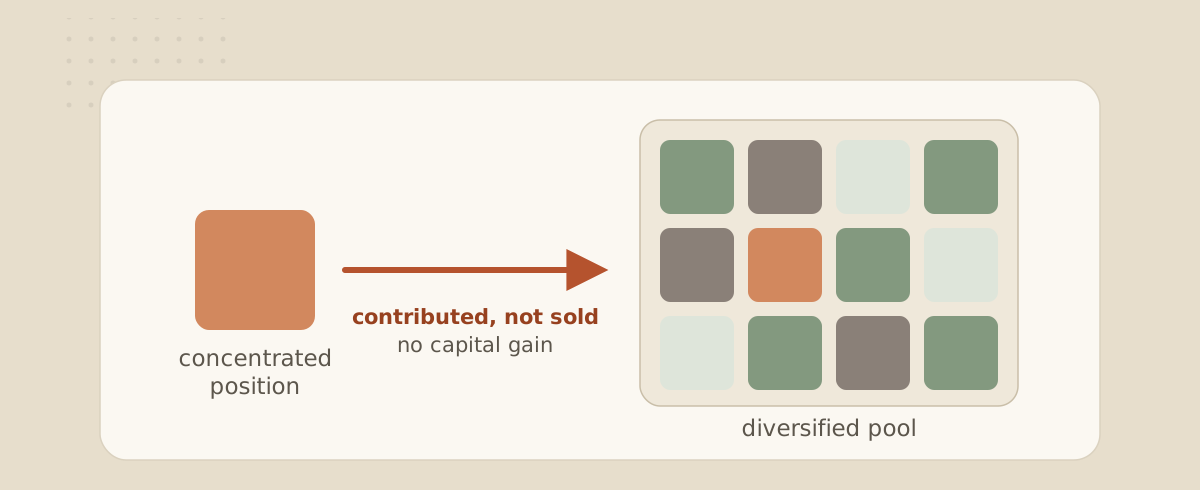
An exchange fund, sometimes called a swap fund, is a partnership that pools concentrated stock positions from many investors. You contribute your shares - so do dozens of other investors, each concentrated in something different. In return, you receive a partnership interest in the diversified pool. Nobody sold anything, so under the partnership tax rules, generally no capital gain is triggered by the contribution itself.
Don't confuse exchange funds with exchange-traded funds. An ETF is a security you buy with cash. An exchange fund is a private vehicle you enter with appreciated stock, and it comes with lockups and qualification requirements.
How does the tax deferral actually work?
Contributions of property to a partnership are generally tax-free under Section 721 of the tax code. That rule is the foundation of every exchange fund.
There's one famous exception. If the partnership counts as an "investment company" under the tax rules, contributions become taxable - which would defeat the entire point. Exchange funds are structured to avoid that classification, and the workaround is why they look a little odd on paper. The fund holds a slice of qualifying assets, commonly real-estate-related holdings, alongside the contributed stocks. That is the feature keeping your contribution tax-free.
Two more rules shape the experience. Partnership tax law generally looks back 7 years - if contributed property is distributed to another partner, or other property is distributed to you, within 7 years of your contribution, gain can be triggered under Sections 704(c) and 737. That's the statutory root of the 7-year holding period every exchange fund describes.
What happens after 7 years?
At the end of the period, funds typically let you redeem your interest in kind - instead of cash, you receive a basket of stocks drawn from the fund's holdings. Your original cost basis generally carries over to the new diversified basket. The gain didn't disappear; it moved into a diversified set of positions you can now manage, harvest, gift, or hold on your own schedule. Deferral, not elimination, and in a diversified wrapper.
Who can invest, and what does it cost?
These are private placements. Eligibility varies by fund, but many exchange funds require Qualified Purchaser status - some structures may be available to Accredited Investors. Qualified Purchaser generally means $5 million or more in investments, and fund minimums commonly start in the high six figures. Costs include management fees on the pooled vehicle. And your diversification is only as good as the pool - you're swapping single-stock risk for the aggregate of what everyone else contributed, which is broader, but not an exact replica of the index.
The trade-offs
| What you gain | What you give up |
|---|---|
| Diversification without triggering a taxable gain | Liquidity for roughly 7 years |
| Deferral of a large tax bill | Control over the exact holdings |
| A diversified basket at exit, basis carried over | Management fees on the vehicle |
| Estate-planning flexibility with the interest | A slice allocated to qualifying assets |
There are also timing risks - your stock may outperform the pool after you contribute, which is diversification working as intended but never feels that way. Exchange funds carry the risk of loss like any investment, and past results of any pool say nothing about the next 7 years.
How do exchange funds compare with the alternatives?
They sit in a toolkit, not on a pedestal. Staged selling pays the tax but buys simplicity and full control. Options-based hedges manage risk while you decide. Long/short overlays let you slowly whittle away at the concentrated position. The right answer is often a combination sized to your tax basis, timeline, and tolerance for lockups.
Common questions
Do exchange funds eliminate capital gains tax?
No. They defer it. Your basis generally carries into the fund interest and then into the basket you receive at exit. Held until death, current law's basis step-up rules may apply to what your heirs receive, which is an estate-planning conversation.
Can I exit before 7 years?
Funds generally permit early redemption but on unattractive terms, often returning your original shares or the lesser of values, early redemption fees may apply, and an early exit can unwind the tax benefit. Enter assuming you’ll stick it out the full 7 year term.
Is an exchange fund right for equity compensation shares?
Only vested, freely transferable shares can be contributed, and employees should check trading policies and blackout rules first. Whether it fits depends on your tax basis, concentration, liquidity needs, and qualification.
What if I don't want a 7-year lockup?
Then an exchange fund probably isn't your tool, and that's a fine answer. Staged selling spreads the tax bill on your schedule and pairs naturally with the estimated-tax planning a big sale year requires. Loss harvesting in the rest of the portfolio can offset part of each sale. And a newer family of tax-deferred diversification approaches has been drawing mainstream financial press coverage - different mechanics, different trade-offs. Understand what you're giving up before you admire what you're deferring.
The exchange fund is one of the few tools that attacks the concentration problem without first creating a tax problem. It pays for that trick with time and constraints. For the right position, a large gain, a long horizon, no near-term need for the money, it can be the difference between diversifying this year and putting it off.
Valence Wealth is an investment adviser registered in the State of Arizona.
Disclosures: The information provided is for educational and informational purposes only and does not constitute investment, tax, or legal advice and should not be relied on as such. It is not a solicitation to buy or an offer to sell any security. It does not take into account any individual's particular investment objectives, financial situation, or needs. You should consult your own financial advisor, tax advisor, or attorney before acting on any information herein. All investing involves risk, including the possible loss of principal. Figures and tax limits referenced are for the applicable tax year and are subject to change. Valence Wealth, LLC is a registered investment advisor in the State of Arizona. Registration does not imply any specific level of skill or training.
Sources
- 26 U.S.C. Section 721: nonrecognition on contributions to a partnershipCornell Legal Information Institute
- 26 U.S.C. Section 737: recognition on certain distributions within 7 yearsCornell Legal Information Institute
- 26 U.S.C. Section 704(c): contributed property rulesCornell Legal Information Institute
- IRS Topic 559: net investment income taxInternal Revenue Service
- 15 U.S.C. Section 80a-2(a)(51): qualified purchaser definitionCornell Legal Information Institute
- IRS Topic 409: capital gains and lossesInternal Revenue Service
- Ways to diversify concentrated stock positionsFidelity
- Accredited investorInvestor.gov
- How wealthy investors defer capital gains when diversifyingCNBC