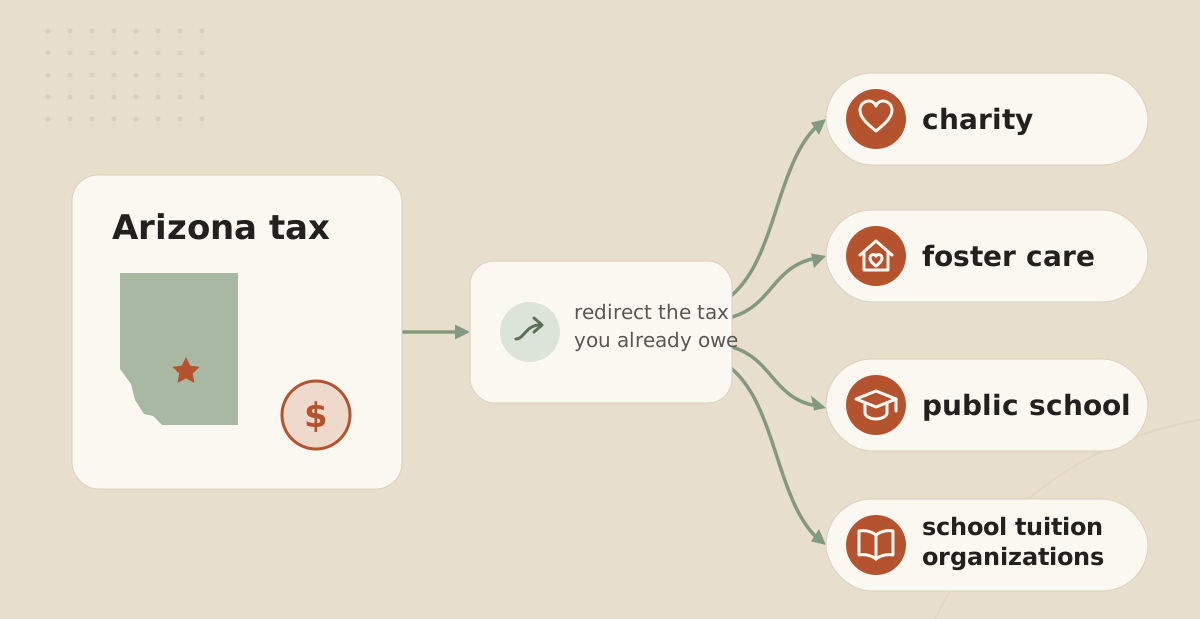
A married Arizona couple can redirect as much as $5,802 of their 2026 state income tax to charities and schools they choose instead of sending it to the state. Five commonly used credits do the work: the Qualifying Charitable Organization (QCO) credit, the Qualifying Foster Care Charitable Organization (QFCO) credit, the public school credit, and two private school tuition organization credits. For a single filer the stack tops out at $2,909.
These are credits, so a $506 gift to a qualifying charity generally cuts your Arizona tax bill by $506. The money was leaving your account either way. The only question is whether it goes to the Department of Revenue or to a food bank you chose.
In my experience, these credits get skipped for a simple reason: each one looks too small to bother with. Individually, that's fair. Stacked, and repeated every year, a joint-filing couple can direct something like $58,000 of tax over a decade. This is housekeeping. The caps are too low for it to be strategy. But it's housekeeping with a five-figure decade attached, so it deserves 30 minutes of your December.
What are these five credits, and what are they worth?
The five in this stack are the Qualifying Charitable Organization credit, the Qualifying Foster Care Charitable Organization credit, the public school credit, and the original and switcher private school tuition credits, worth up to $5,802 combined for joint filers in 2026. Arizona offers other individual credits too; these five are the donation and school credits that stack.
Each credit has its own form, its own list of eligible recipients, and its own cap. The QCO, QFCO, and both tuition credits index annually for inflation. The public school credit doesn't; it's been $200 and $400 under A.R.S. section 43-1089.01 for years. All figures below are the 2026 tax year maximums published by the Arizona Department of Revenue on its QCO and QFCO credit page.
| Credit | Form | 2026 max, single | 2026 max, MFJ | Deadline for 2026 |
|---|---|---|---|---|
| Qualifying Charitable Organization (QCO) | 321 | $506 | $1,009 | April 15, 2027 |
| Qualifying Foster Care Charitable Organization (QFCO) | 352 | $632 | $1,262 | April 15, 2027 |
| Public school (fees or contributions) | 322 | $200 | $400 | April 15, 2027 |
| Private school tuition organization, original | 323 | $787 | $1,570 | April 15, 2027 |
| Private school tuition organization, switcher | 348 | $784 | $1,561 | April 15, 2027 |
| Total | $2,909 | $5,802 |
Two mechanics worth knowing. The switcher credit (Form 348) only opens up after you've given the maximum under the original credit (Form 323), so the two certified school tuition organization credits work as a sequence, and the receiving School Tuition Organization must be certified by the state. And every recipient needs a code on your return: QCOs and QFCOs carry a 5-digit state code, public schools a 9-digit CTDS number. The charity's receipt usually has it. Check anyway.
How does this interact with the 2.5% flat tax?
Arizona's flat 2.5% rate ties your credit capacity straight to income: a joint filer's Arizona tax generally covers the entire 2026 stack of $5,802 once Arizona taxable income reaches about $232,000, and below that, any excess generally carries forward.
Arizona's individual income tax has been a flat 2.5% since 2023, which makes the arithmetic easy. Here's a rounded hypothetical for illustration only: a married couple filing jointly with $600,000 of Arizona taxable income owes about $15,000 of Arizona tax. The full 2026 credit stack of $5,802 could redirect roughly 39% of that bill.
That's the high-earner frame. If you're an executive with RSU income landing on top of salary, your Arizona liability is generally large enough to absorb every one of these credits, every year. The constraint is remembering to write the checks. And if you arrived in Arizona recently, the year-of-move split has its own rules, which I covered in the piece on moving here with unvested equity.
Why does the deadline run to April 15?
The deadline runs to April 15 because the Arizona credit statutes generally let you elect to treat a contribution made on or before the 15th day of the fourth month after year-end as if you had made it on the last day of the prior year. This is the quirk that rescues procrastinators.
The QCO and QFCO credit statute, and its counterparts for the other credits, carry that rule. So a gift made between January 1 and April 15, 2027 can count for either 2026 or 2027.
Which means you can sit down to prepare your Arizona return in March, see the liability you just worked out, and still redirect part of it. The tax year is closed for almost everything else. For these credits it's open until tax day.
One catch: the cap that applies is the cap for the year you claim. Give in February 2027 and claim it for 2026, and you're under the 2026 maximums. If you want the higher, inflation-adjusted 2027 cap, you claim it on the 2027 return instead.
What happens on your federal return?
On your federal return, your charitable deduction for these gifts generally has to be reduced by the state credit you receive, and because these Arizona credits run dollar for dollar, that federal deduction is generally zero.
Here's where people overestimate the move. Before 2018, you could often claim a federal charitable deduction for the same gift and come out ahead. The IRS closed that in its 2019 final regulations on SALT-cap workarounds.
There's a consolation prize. A safe harbor under Notice 2019-12 lets itemizers treat the disallowed amount as a state tax payment instead, subject to the federal SALT deduction cap.
For 2026, that cap is $40,400 for joint and single filers alike, but it generally begins phasing down once modified adjusted gross income exceeds $505,000, and the phasedown can pull it as low as $10,000 (the cap and the threshold are halved for a married individual filing separately). Those figures sit in section 164(b)(7) of the Internal Revenue Code. For many highly compensated executives, Arizona income tax and property tax already consume whatever SALT deduction remains, so the practical effect of the safe harbor is usually nothing.
Net of everything, the honest framing: federally, these gifts are generally close to a wash. You're choosing where Arizona tax you already owe ends up. If your goal is a federal tax benefit from charitable giving, that's a different strategy. Long-term appreciated stock is often better raw material, because you may be able to deduct its fair market value while avoiding realization of the embedded capital gain, subject to the charitable deduction rules and limitations in IRS Publication 526. Stock held 1 year or less is generally treated as ordinary income property instead, and the deduction is generally limited to your basis.
The fine print that trips people up
- Nonrefundable, with a 5-year carryforward. A credit can't take your Arizona tax below zero, but unused amounts generally carry forward up to 5 consecutive years.
- Cash only. These credits generally require cash contributions (or, for the public school credit, eligible fees). Donated stock, goods, and volunteered time don't count here.
- No double dip on the state return. You can't claim an Arizona itemized deduction for a contribution you claimed as a credit.
- No round trips. Tuition organization gifts can't be designated for your own dependent, and swap arrangements (you fund my kid, I fund yours) are prohibited by statute.
Where this fits in a real plan
These credits belong on a year-end checklist: pick your organizations once, give at the current-year caps as a December calendar item, and treat the April 15 window as the backstop for the years you forget.
In my experience, the cleanest way to handle these is to stop treating them as a tax decision at all. It's a 30-minute task that repeats.
None of this is sophisticated planning. That's the point. A good year-end planning process should catch the $5,802 items automatically, so your attention can stay on the decisions that can move six figures: equity compensation, estimated taxes and safe harbor targets, option exercises, charitable stock gifts, and portfolio gains.
If you want to see how that kind of checklist fits together, the planning work an engagement covers is laid out in detail, along with the flat annual fee that covers it. The credits are the smallest line on it. They're also the easiest line to skip.
If you'd rather hand the whole list to someone in December, you can get in touch to talk it through.
Common questions
Do I need to itemize to claim these credits?
No, you don't need to itemize: these are Arizona credits claimed on their own forms, and they generally work the same whether you take the federal standard deduction or itemize. Your federal filing posture doesn't change your eligibility, though it can change the (usually minor) federal side effects described above.
What if my credits are more than my Arizona tax for the year?
The credits are nonrefundable, so they can only zero out your liability, and any excess generally carries forward for up to 5 consecutive tax years.
For high earners this rarely comes up, since a 2.5% flat tax on a large income generally clears the full stack. It matters more in a low-income year, like a sabbatical or a year of large losses.
Can I give appreciated stock instead of cash?
Generally no, these Arizona credits require cash contributions, so a gift of appreciated stock doesn't qualify for them.
Appreciated stock belongs in your federal charitable planning instead, where donating shares can remove embedded capital gains, subject to the capital gain property rules in IRS Publication 526. Many families run both: cash for the Arizona credits and appreciated stock for separate federal charitable giving.