If you're paid in RSUs and ESPP shares, every vest this year added to your taxable income at a withholding rate that may not match your bracket. This year-end tax checklist covers nine moves and when each one has to happen - before your last 2026 paycheck, by December 31, by the January 15 estimated payment, when you file, or before your first 2027 vest - so you can see what needs attention first and come back for the rest.
| Strategy | Applies to you if | Next action | Deadline |
|---|---|---|---|
| 1.Close the withholding gap | RSUs vested in 2026 | Estimate the gap, then add withholding or an estimated payment | Last 2026 payroll, or January 15, 2027 |
| 2.Harvest losses | You hold investments at a loss in a taxable account | Check 30 days before and after each sale for purchases | December 31 |
| 3.Fix cost basis | You sold RSU or ESPP shares in 2026 | Get your broker's supplemental statement | April 15, 2027 |
| 4.Max the 401(k) | You haven't contributed $24,500, or you're 50+ with room for a catch-up contribution | Raise your deferral election | Last 2026 payroll |
| 5.Mega backdoor Roth | Your plan allows after-tax contributions and Roth conversion or in-service withdrawals | Set the after-tax election and set up the Roth conversion | Last 2026 payroll |
| 6.Max the HSA | You have HDHP coverage and no disqualifying coverage | Raise your payroll HSA contribution | Last 2026 payroll, or April 15, 2027 directly |
| 7.Donate shares, not cash | You plan to give to charity this year | Pick appreciated shares held over a year and start the transfer | December 31, start early December |
| 8.Roth conversion | Your 2026 income dropped sharply and you're in a low tax bracket | Estimate the room left in your bracket | December 31 |
| 9.Set up 2027 for success | You have RSU vests in 2027 | Check withholding options and vest dates | Before your first 2027 vest |
1. Close the RSU withholding gap
When RSUs vest, employers commonly withhold federal income tax at a flat 22%. Above $1 million of supplemental wages in a year, withholding at 37% is required on the excess. If your income puts you in the 32%, 35% or 37% bracket, 22% doesn't cover it, and the difference comes due in April.
Here's a hypothetical. Say $200,000 of your 2026 income came from RSU vests and your top bracket is 35%. Withholding at 22% took $44,000. At 35%, the federal tax on that income could be as much as $70,000, depending on your full tax picture, which leaves a gap of up to $26,000. Our RSU Tax Gap Calculator runs this estimate with your own numbers.
You have two ways to close the gap. You can make a fourth-quarter estimated payment by January 15, 2027, or you can raise the withholding on your December paychecks. Withholding has an advantage here. The IRS treats tax withheld as if it were paid evenly through the year, so extra withholding in December can cover a shortfall from earlier quarters. An estimated payment counts only from the day you make it.
You may not owe a penalty even if a balance remains. If your 2025 AGI was over $150,000, you generally avoid the underpayment penalty when your 2026 withholding and on-time estimated payments total at least 110% of your 2025 tax. That's why extra December withholding can rescue earlier quarters and a late estimated payment may not. Our guide to safe harbor estimated taxes walks through both safe harbors and the quarterly calendar.
Action steps: Gather your latest paystub, your 2025 tax return and your remaining 2026 vest schedule. Use them to estimate the gap, then choose extra withholding, an estimated payment or both.
2. Harvest losses without tripping wash sales
If you've realized taxable gains throughout the year, you can also realize losses to offset those gains. Losses offset your gains first. Any net loss left over offsets up to $3,000 of ordinary income a year ($1,500 if married filing separately), and the rest carries forward to future years until it is used up. December 31 is the last day to harvest losses for 2026.
The opportunities are often hiding inside positions that look fine overall. You can generally choose which shares you sell, by telling your broker which lot to sell at the time of the sale, so a fund or stock you've bought many times may have individual lots below their cost even if the position as a whole is up. Company shares from a recent RSU vest or ESPP purchase at a higher price are a common example (see move 3 before selling ESPP shares at a loss). You can stay invested by moving the proceeds into a similar investment that isn't substantially identical, such as a fund that tracks a different index. The IRS decides what counts as substantially identical on the facts of each case and hasn't ruled on similar funds, so pick a replacement that is clearly different.
Some investors use strategies built to find losses. Direct indexing holds the individual stocks of an index instead of a fund, so the stocks that fall can be sold at a loss even in a year the index rises. It can cost more than an index fund and can perform differently from the index. Tax-aware long-short strategies aim to produce losses more consistently, but they add cost, complexity and risk. Our RSU tax strategies article covers both.
Equity comp adds a trap.
The wash sale rule disallows a loss if you buy substantially identical stock within 30 days before or after the sale. The IRS's own guidance includes an example where company shares received as a bonus award within 30 days of a loss sale disallow the loss. For an equity comp employee, an RSU vest or an ESPP purchase can work the same way. If you sell company shares at a loss on December 10 and RSUs vest on December 20, part or all of that loss can be disallowed. The disallowed loss usually isn't gone for good. It's added to the cost basis of the new shares, but it doesn't help you this year. The exception is a replacement purchase in your IRA or Roth IRA, which can make the loss permanently disallowed.
There are two ways around it. Harvest losses from your other holdings first, such as index funds or other individual stocks, where no automatic purchase is coming. If you do sell company stock at a loss, check your vest and ESPP purchase calendar and keep the sale more than 30 days away from both. Dividend reinvestment buys new shares, so consider turning it off for any stock you plan to sell at a loss.
Action steps: Pull your realized and unrealized gains and losses for 2026 from each taxable account. For each proposed loss sale, check the full 30 days before and after the sale date for any purchase of the same stock, including RSU vests, ESPP purchases, reinvested dividends and buys in your IRA or Roth IRA. A December sale's window can run into January 2027.
3. Fix your ESPP and RSU cost basis
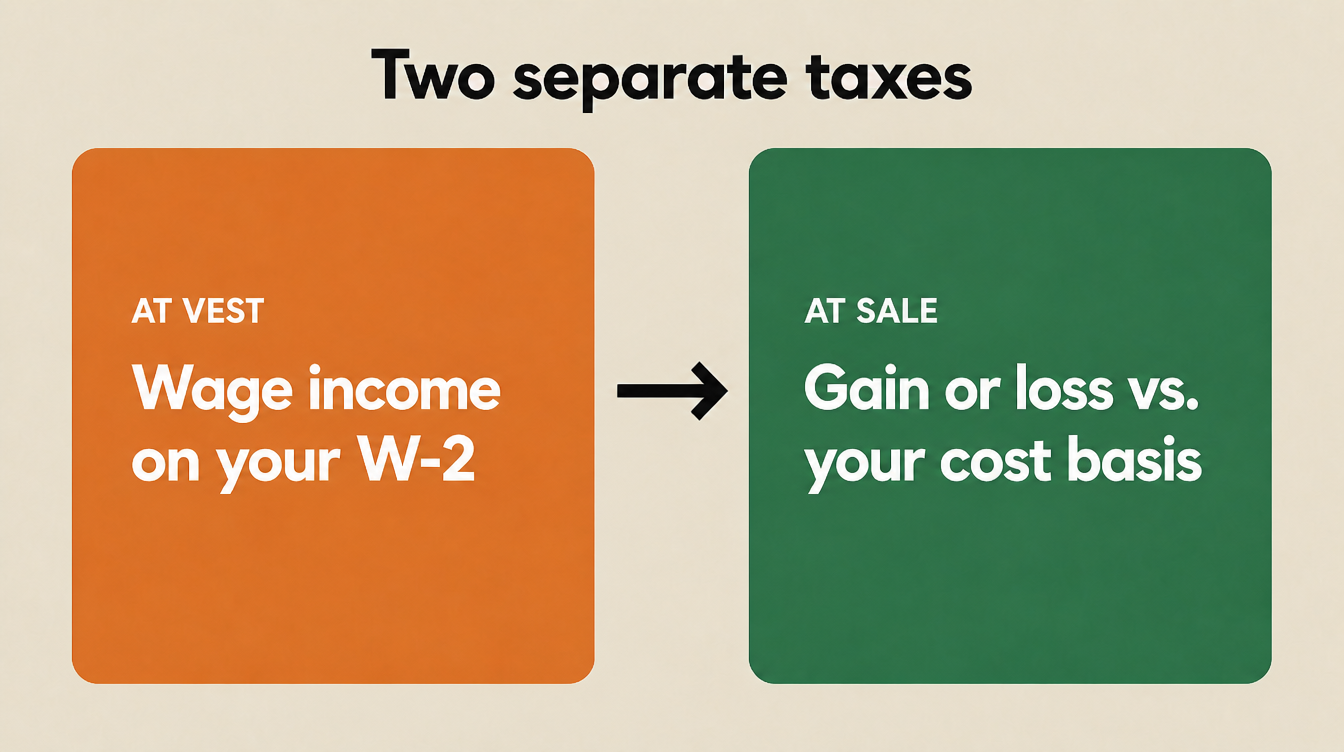
Your RSU vest value is taxed as wages on your W-2. When you sell ESPP shares, part of the sale is usually taxed as ordinary income in the year you sell, often included on your W-2. If you sell before the holding periods described below, that part is the full difference between the share price on the purchase date and what you paid, even if the shares have since lost value. On a qualifying sale, it's the smaller of the discount measured at the start of the offering and your actual gain. When you sell either kind of share, the Form 1099-B from your broker often reports a cost basis that leaves that income out, showing only the price you paid for ESPP shares, or a basis of zero for RSUs. File with that number and you pay tax on the same income twice.
The fix happens when you file. Many brokers send a supplemental statement with the adjusted basis, and you use it to report the correct basis on Form 8949. If yours doesn't, use your vest and purchase confirmations. Our Microsoft ESPP guide shows how this works step by step for one plan.
If you're thinking about selling ESPP shares in December, check the dates first. A sale is a qualifying disposition, with more of the gain taxed at capital gains rates, only if you've held the shares more than two years from the offering date and more than one year from the purchase date. A few weeks can change the tax treatment.
Waiting has a cost, though. Holding ESPP shares longer to reach a qualifying sale keeps that money in your employer's stock, and having a large portion of your assets in one stock can mean steep losses if that stock underperforms. A drop in the share price while you wait can outweigh the tax you'd save, so weigh the potential tax savings against how much of your wealth already depends on your employer.
Action steps: Download your 2026 RSU vest confirmations and ESPP purchase statements, and find out where your broker posts its supplemental cost basis statement. Before any December ESPP sale, note the offering and purchase dates.
4. Max the 401(k)
For 2026, you can defer up to $24,500 into your 401(k), as pre-tax, Roth or a mix of both. If you're 50 or older by year-end, you can add an $8,000 catch-up contribution, or $11,250 if you're 60 through 63.
A new rule applies from 2026. If your FICA wages from your employer for 2025 were more than $150,000, any catch-up contributions you make in 2026 must be Roth. Your regular $24,500 can still be pre-tax. For most of our readers, this means the catch-up no longer lowers this year's taxable income.
Deferrals come out of your paychecks, so the deadline is your last payroll of the year, not December 31. You can't write a check in April to catch up. Check with HR or your plan's website for the cutoff to change your election. If you hit the limit early in the year, also check whether your plan "trues up" the match. Without a true-up, some plans only match contributions in the pay periods you actually contribute. Our guides to the Amazon 401(k) and Microsoft 401(k) cover how Amazon and Microsoft handle this.
Action steps: Check your year-to-date deferrals on your 401(k) website against $24,500, plus catch-up if you're 50 or older, and ask HR for the last date to change your 2026 election.
5. Mega backdoor Roth
The $24,500 limit covers your own deferrals, but the IRS caps total contributions to your 401(k), counting your deferrals, your employer's match and any after-tax contributions together, at $72,000 for 2026. If your plan allows after-tax contributions, the space above your deferrals and the employer match can be filled with after-tax money, which you then convert to Roth. That's the mega backdoor Roth.
The conversion is an extra step. It's easy to make after-tax contributions without realizing you also have to elect the conversion. Until you do, the money sits as after-tax savings, and its growth is taxed as income when it's withdrawn. If your plan offers automatic in-plan Roth conversion, turn it on. Converting promptly also matters. The money you put in has already been taxed, but earnings before the conversion are taxable, and an automatic conversion, same-day in some plans, keeps those earnings small.
Two things to confirm before December. The plan has to allow both after-tax contributions and either in-plan Roth conversions or in-service withdrawals. And like your deferrals, after-tax contributions come out of your paychecks, so only the payrolls left in the year can carry them.
Action steps: Confirm in your plan documents that after-tax contributions and Roth conversion are allowed, count the paychecks left in 2026, and turn on automatic Roth conversion if your plan offers it.
6. Max the HSA
If you're covered by a high-deductible health plan and have no other disqualifying coverage, such as a general-purpose health FSA or Medicare, you can contribute to a health savings account. The 2026 limits are $4,400 for self-only coverage and $8,750 for family coverage, plus $1,000 if you're 55 or older. HSA contributions are deductible, growth isn't taxed, and withdrawals for qualified medical expenses are tax-free. For most people, it's the only account that gets all three tax breaks.
Contributions through your employer's payroll, under a cafeteria plan, are generally also excluded from Social Security and Medicare taxes. Contributions you make directly to the HSA are deducted on your tax return instead, and that deduction doesn't recover the payroll taxes already paid on that money. If you have room left, increase your payroll contribution before your last paycheck. Anything you can't fit through payroll can still go in directly until April 15, 2027.
Some people treat the HSA as a long-term account. They invest the balance, pay current medical bills out of pocket, and keep the receipts, since a qualified expense incurred after you opened the HSA can generally be reimbursed later.
Action steps: Confirm your HDHP coverage, add up your year-to-date HSA contributions including any from your employer, and raise your payroll contribution for the paychecks left.
7. Donate shares, not cash
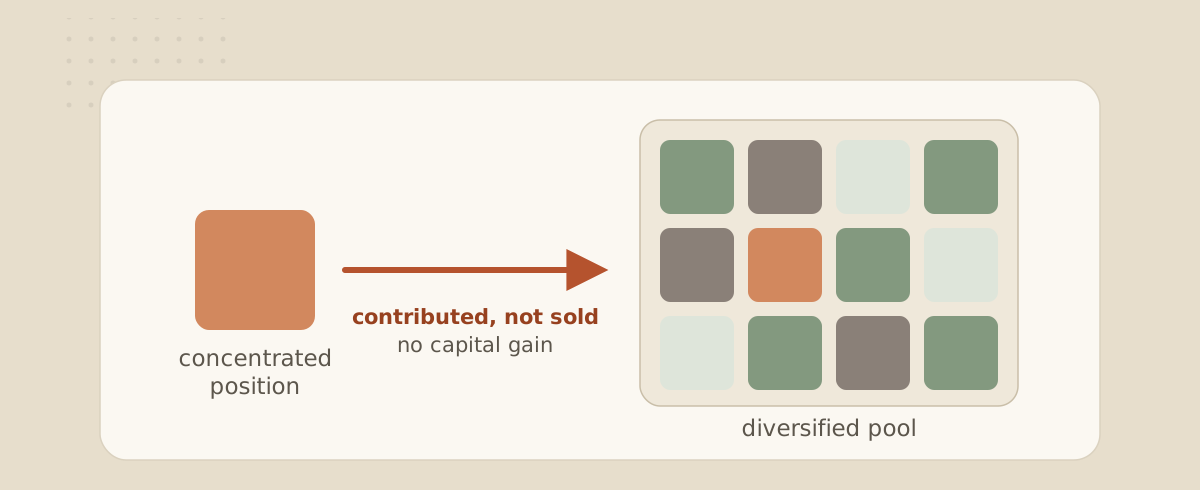
If you plan to give to charity this year, consider giving appreciated shares instead of cash. When you donate stock you've held more than a year to a public charity, you can generally deduct its full market value if you itemize, up to 30% of your AGI, with any excess carried forward. And because you donate the shares rather than selling them, you don't realize the taxable gain.
For example, say you give $10,000 of shares you bought for $4,000. Your deduction could be up to $10,000, the same as a cash gift, subject to the 2026 limits below. And since you don't sell the shares, you also don't report the $6,000 taxable gain. Give cash instead and sell the shares later, and that gain is taxable.
One caution for equity comp. Shares held one year or less, which includes RSUs that vested within the last year, are generally deductible only up to your cost basis or their fair market value, whichever is less, so the advantage disappears.
In a large vest year, a donor-advised fund lets you make several years of gifts at once, take the deduction this year, and recommend grants to charities spread out over time. Start stock transfers by early December, since they take longer than writing a check.
The rules for charitable deductions changed in 2026 under the One Big Beautiful Bill Act. Itemized charitable gifts are now deductible only to the extent they exceed 0.5% of your AGI, and if you're in the 37% bracket, the tax value of itemized deductions is capped at 35%. If you don't itemize, you can now deduct up to $1,000 of cash gifts to public charities, or $2,000 if married filing jointly, but gifts to a donor-advised fund don't qualify. Our RSU tax strategies article covers giving shares in more detail.
Action steps: Choose shares held more than a year with the largest gain relative to their value. Ask the charity or donor-advised fund for its brokerage transfer instructions, and start the transfer by early December.
8. Convert to Roth in a low-income year
A Roth conversion moves money from a pre-tax IRA or 401(k) into a Roth account. You pay income tax on the amount converted now, and qualified withdrawals later are tax-free. If you're in the 32% to 37% brackets, every dollar you convert is taxed at that rate or higher. A low-income year changes that.
A layoff, a sabbatical, or a gap between jobs can drop your income by several brackets for a single year. That year can be a window to convert part of your pre-tax savings at a lower rate than you'd pay later. The usual approach is to convert just enough to fill the lower brackets, not your whole balance.
The deadline is December 31, and a conversion can't be reversed once it's done. Pay the tax from cash rather than from the converted money if you can. And if you're buying health coverage through the marketplace after a layoff, a conversion raises the income used to calculate your premium tax credit, which can reduce or eliminate the credit. From 2026, any advance credit you received above what you qualify for must be paid back in full when you file. And if you're on Medicare, or will be within two years, a conversion raises the income used to set your Medicare Part B and Part D premiums, the income-related monthly adjustment amount or IRMAA, generally two years later.
Action steps: If your 2026 income dropped, estimate your taxable income for the year and how much room is left before the next bracket, using the 2026 brackets. Set aside cash for the tax before you convert.
9. Set up 2027 for success
You can shrink next year's withholding gap before your first 2027 vest. Find out whether your employer lets you choose a higher withholding rate on RSUs. If not, you can raise withholding on your salary through a new Form W-4, or plan quarterly estimated payments.
Map your 2027 vest dates and ESPP purchase dates against your company's trading windows, so you know when you can sell and when a sale might trigger a wash sale. If you're an officer or director, or often have access to inside information, ask about a Rule 10b5-1 trading plan, which lets you schedule sales in advance.
Open enrollment is the last step. It's where you choose a high-deductible plan if you want HSA eligibility, set your FSA elections, and in some plans set the after-tax 401(k) election for the mega backdoor Roth.
Action steps: Ask HR or your equity plan administrator whether you can elect a higher RSU withholding rate, download your 2027 vest schedule and your company's trading window calendar, and finish your open enrollment elections.
Quick wins before December 31
Two smaller items are easy to miss. If you have a health or dependent care FSA, spend the balance, because most FSA money is use-it-or-lose-it. Check whether your plan offers a grace period of up to two and a half months or, for a health FSA, a carryover, which is capped at $680 into 2027. And download your 2026 vest confirmations and ESPP purchase statements now. You'll need them for move 3.
This is a summary of general tax rules, not a recommendation. Whether any of these moves makes sense depends on your full financial picture, your tax situation and your goals. The dollar examples are hypothetical illustrations, not projections or results. Tax rules and plan terms can change, so confirm the details with your plan administrator or tax professional before acting.
Need help coordinating your year-end tax decisions?
Schedule a complimentary introductory call with a CFP® professional to discuss your situation and how Valence could help.
Book an intro callDisclosures: The information provided is for educational and informational purposes only and does not constitute investment, tax, or legal advice and should not be relied on as such. It is not a solicitation to buy or an offer to sell any security. It does not take into account any individual's particular investment objectives, financial situation, or needs. You should consult your own financial advisor, tax advisor, or attorney before acting on any information herein. All investing involves risk, including the possible loss of principal. Figures and tax limits referenced are for the applicable tax year and are subject to change. Valence Wealth, LLC is a registered investment advisor in the State of Arizona. Registration does not imply any specific level of skill or training. Valence Wealth is not affiliated with, endorsed by, or sponsored by any employer named in this article. Hypothetical examples are not actual results or forecasts.
Sources
- IRS Publication 15 (Circular E), Employer's Tax Guide, supplemental wagesInternal Revenue Service
- Revenue Procedure 2025-32: 2026 inflation adjustmentsInternal Revenue Service
- Form 1040-ES, Estimated Tax for Individuals, 2026Internal Revenue Service
- Instructions for Form 2210, underpayment of estimated taxInternal Revenue Service
- IRS Publication 550, Investment Income and Expenses (wash sales and capital losses)Internal Revenue Service
- IRS Publication 525, Taxable and Nontaxable Income (employee stock purchase plans)Internal Revenue Service
- Instructions for Form 1099-B, 2026Internal Revenue Service
- Instructions for Form 8949Internal Revenue Service
- IRS: 401(k) limit increases to $24,500 for 2026 (IR-2025-111)Internal Revenue Service
- IRS Notice 2025-67: 2026 limitations for retirement plansInternal Revenue Service
- IRS: retirement topics, catch-up contributionsInternal Revenue Service
- Revenue Procedure 2025-19: 2026 HSA limitsInternal Revenue Service
- IRS Publication 969, Health Savings Accounts and Other Tax-Favored Health PlansInternal Revenue Service
- IRS Publication 526, Charitable ContributionsInternal Revenue Service
- Public Law 119-21 (One Big Beautiful Bill Act), sections 70111, 70424 and 70425U.S. Government Publishing Office
- IRS Publication 590-A, Contributions to Individual Retirement Arrangements (Roth conversions)Internal Revenue Service
- IRS Publication 974, Premium Tax CreditInternal Revenue Service
- 17 CFR 240.10b5-1, trading plansLegal Information Institute