Arizona's flat income tax rate is 2.5%. You can deduct 25% of qualifying net long-term capital gains from assets acquired after December 31, 2011, when calculating your state income. Arizona calls this adjustment a capital gains subtraction. That produces an effective state rate of 1.875%, before other deductions and credits. The examples below assume you're an Arizona resident for the full year.
If you're selling company stock, the deduction applies to qualifying capital gains after vesting or purchase. You don't need to itemize to claim it.
What is Arizona's capital gains tax rate?
Arizona taxes salary and capital gains at the same 2.5% rate. The deduction means only 75% of a qualifying long-term gain is subject to state tax.
Consider a hypothetical full-year Arizona resident who sells qualifying shares held for three years.
- Qualifying net long-term gain: $200,000
- Arizona tax before the deduction: approximately $5,000
- Arizona tax after the deduction: approximately $3,750
The $50,000 deduction leaves $150,000 taxable in Arizona. State tax savings could be roughly $1,250 before credits. Federal capital gains tax may still apply.
What qualifies for the 25% deduction
A gain generally becomes long-term after you hold an asset more than one year. To claim the deduction, the qualifying net gain must be included in federal adjusted gross income (AGI), and you must be able to verify the acquisition date.
| Situation | 25% deduction |
|---|---|
| Qualifying net long-term gain from assets acquired after December 31, 2011 | Yes |
| Asset acquired before 2012 | No |
| Short-term gain | No |
| Acquisition date can't be verified | No |
| Gifted or inherited asset | Uses the giver's or decedent's acquisition date |
| RSU vest income and ESPP ordinary income | No, taxed as wages |
For gifts and inheritances, use the giver's or decedent's acquisition date. Shares inherited last year from a parent who bought them in 1995 don't qualify.
Long-term losses on assets acquired after 2011 are netted against those gains before the 25% applies.
RSUs, ESPP shares and the deduction
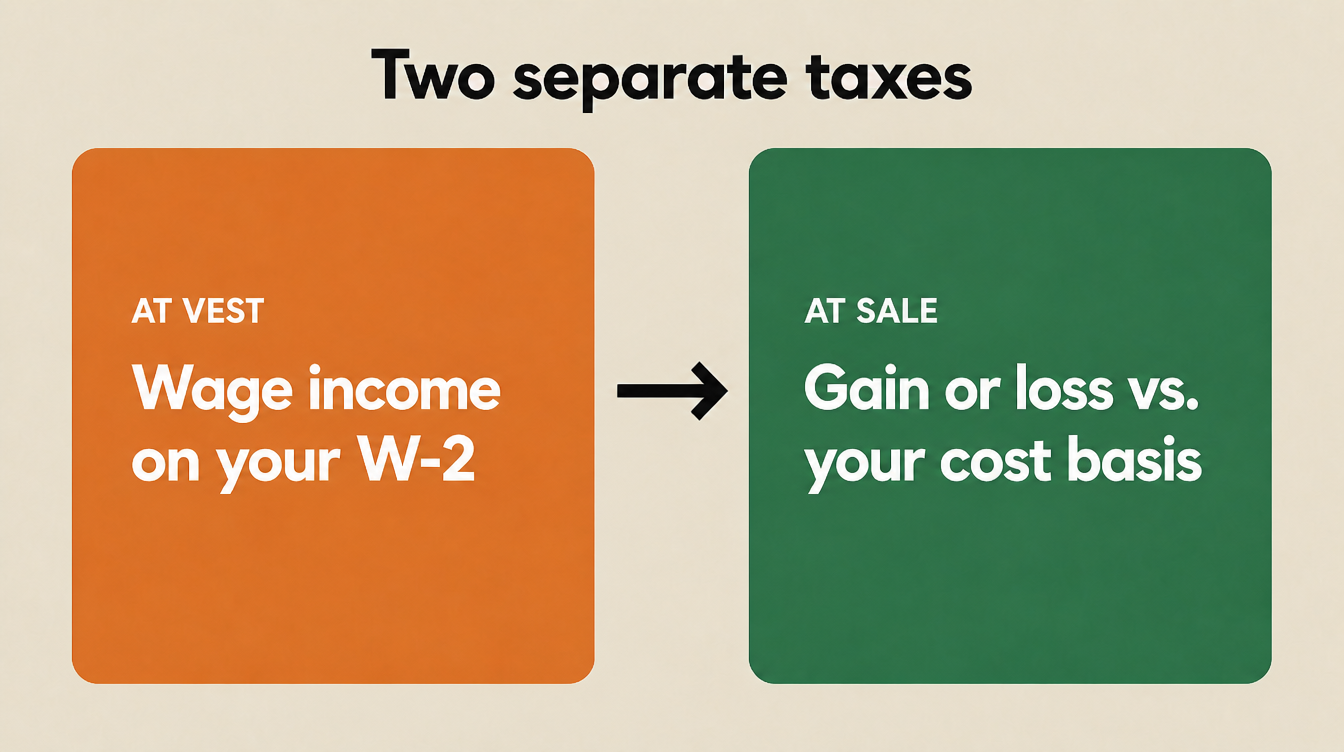
RSUs are taxed in two parts. The value of your shares at vest is generally taxed as wages, at Arizona's full 2.5%. Only the growth after vest is capital gain, and only shares held more than a year after vesting produce a long-term gain. On an ESPP sale, part of the profit is usually ordinary income, and only the capital gain layer can qualify. Our RSU tax guide covers the federal side.
The state tax benefit alone isn't a reason to hold a concentrated position longer, because a drop in the share price while you wait can cost more than the tax you'd save.
How the federal SALT cap fits in
The federal state and local tax (SALT) deduction covers eligible state income and property taxes if you itemize. The 2026 cap is $40,400, with the higher cap scheduled to end after 2029.
For single and joint filers, the cap falls by 30 cents for each dollar of modified adjusted gross income (MAGI) above $505,000 in 2026, reaching a $10,000 floor at approximately $606,333. Separate limits apply if you're married filing separately. Capital gains and RSU vest income count toward MAGI.
A hypothetical married couple filing jointly has $480,000 of MAGI before realizing a $100,000 long-term gain. At $580,000 of MAGI, their cap would fall by $22,500 to $17,900. That $22,500 reduces the cap. It isn't automatically a lost deduction or a higher tax bill. The lower cap limits their deduction only if their eligible taxes paid exceed $17,900 and they itemize.
Arizona's 25% deduction doesn't reduce federal AGI or MAGI. The full gain still counts toward the $505,000 threshold. On the Arizona return, itemizers can deduct no more than $10,000 of state and local taxes starting in 2026.
Three checks before you sell
- Check the dates on each lot. Your cost basis report generally shows which shares were acquired after 2011 and held more than a year.
- Keep the paperwork. Save vest confirmations, ESPP purchase statements and Forms 1099-B to verify acquisition dates.
- Model the federal effect. Add the expected gain to your household's MAGI and check whether a lower SALT cap would actually limit your deduction. You can model sales across two tax years with your tax professional, weighed against the risk of holding the stock longer.
A large gain can also leave your withholding short, so check it against the safe harbor for estimated taxes.
You may also be able to redirect part of your remaining Arizona tax bill to eligible charities and schools through Arizona's tax credits.
Before selling, confirm which lots qualify and estimate the state and federal tax consequences.
Planning a large stock sale?
Schedule a complimentary introductory call with a CFP® professional to discuss your situation and how Valence Wealth could help.
Book an intro callDisclosures: The information provided is for educational and informational purposes only and does not constitute investment, tax, or legal advice and should not be relied on as such. It is not a solicitation to buy or an offer to sell any security. It does not take into account any individual's particular investment objectives, financial situation, or needs. You should consult your own financial advisor, tax advisor, or attorney before acting on any information herein. All investing involves risk, including the possible loss of principal. Figures and tax limits referenced are for the applicable tax year and are subject to change. Valence Wealth, LLC is a registered investment advisor in the State of Arizona. Registration does not imply any specific level of skill or training. Hypothetical examples are not actual results or forecasts.
Sources
- A.R.S. section 43-1022, Subtractions from Arizona gross income (paragraph 22)Arizona State Legislature
- A.R.S. section 43-1001, Definitions (Arizona gross income)Arizona State Legislature
- 2025 Arizona Form 140 instructions (lines 20 to 24, line 46 and the subtraction worksheet)Arizona Department of Revenue
- Form 140 X and Y Tables notice (flat 2.5% rate from tax year 2023)Arizona Department of Revenue
- A.R.S. section 43-1042, Itemized deductions (subsection D)Arizona State Legislature
- 26 U.S.C. section 164(b)(6) and (b)(7), limit on the deduction for state and local taxesLegal Information Institute
- IRS Topic No. 503, Deductible taxesInternal Revenue Service
- IRS Topic No. 409, Capital gains and lossesInternal Revenue Service
- IRS Topic No. 559, Net investment income taxInternal Revenue Service
- IRS Publication 525, Taxable and Nontaxable Income (restricted property and employee stock purchase plans)Internal Revenue Service