A good year with your equity compensation can bring a big tax bill, and a big tax bill brings all kinds of crazy tax schemes. Some come from promoters. Some come from your social media feed. A few come from friends who swear their CPA signed off.
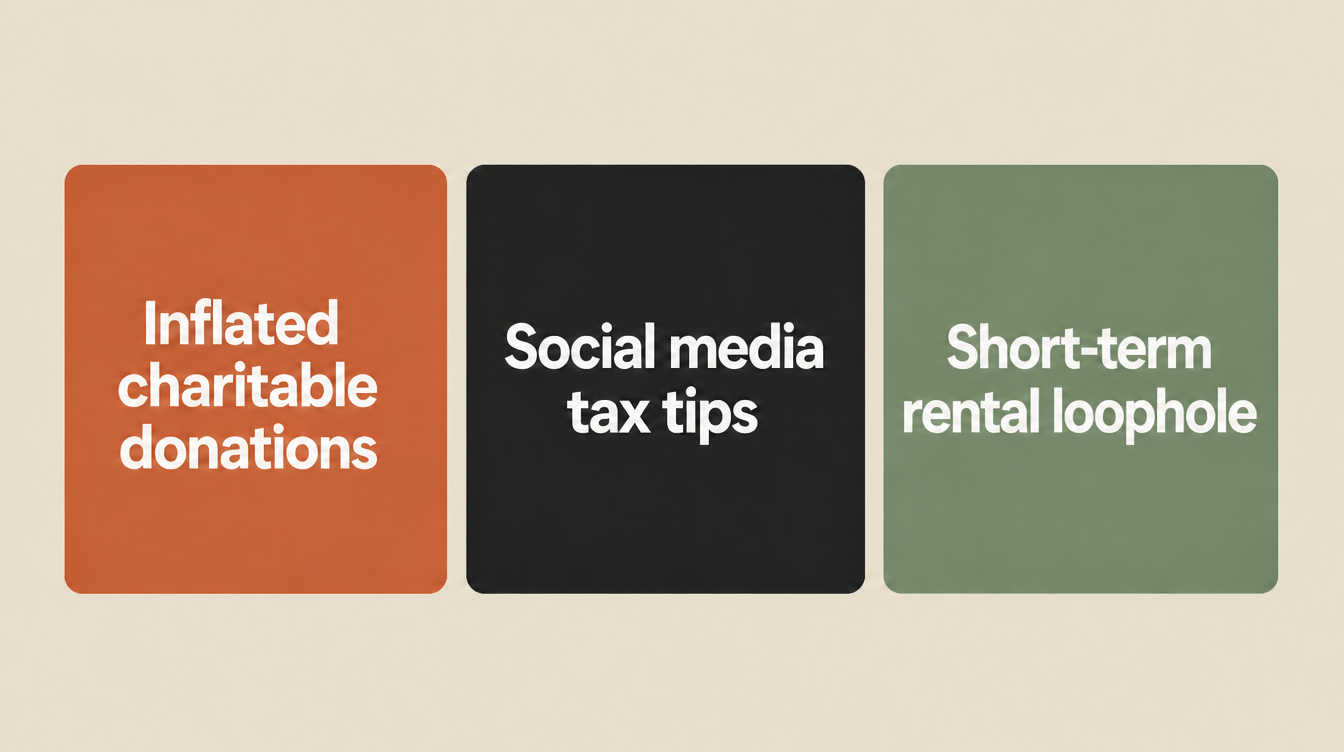
In this article we highlight three tax schemes to avoid in 2026. For each one, you'll see how the pitch works, where it breaks, and what it can cost you.
What is the IRS Dirty Dozen for 2026?
The Dirty Dozen is the IRS's annual list of tax scams for taxpayers to watch for. The 2026 list includes non-cash charitable contribution schemes built on inflated appraisals, misleading tax advice on social media, and promotions of a so-called "Self-Employment Tax Credit."
The IRS describes the list as a warning to taxpayers. If a scheme made the list, you probably want to stay away.
Scheme 1 - Leveraged Charitable Donations
How the donation pitch works
Here's a hypothetical situation. A promoter offers you a deal: pay $50,000, and they'll acquire assets on your behalf, such as artwork, collectibles or rights to a piece of technology. An appraiser values those assets at $250,000. You donate them to a charity and deduct $250,000.
If every dollar of that deduction were saved at a 35% federal rate, the savings could be as high as $87,500 - on only a $50,000 outlay. On paper, it looks like a great return.
Where the donation pitch breaks
Ask one question. If the assets were worth $250,000, why did the seller let them go for $50,000?
The IRS uses almost the same logic. Its guide to valuing donated property, Publication 561, describes a promoter selling gems for $5,000 and telling the buyer to deduct $15,000 after holding them more than a year. The IRS says the $5,000 purchase price is the best evidence of the gems' maximum fair market value.
A few other rules work against these deals:
- Short holding periods. If you held the property one year or less, your deduction is generally limited to what you paid, not the appraised value.
- Income limits. Non-cash gifts to public charities are generally capped at 50% of your adjusted gross income (AGI), or 30% for long-term capital gain property. Anything above the cap carries forward. A $250,000 deduction for long-term capital gain property would need more than $800,000 of AGI to use in one year.
- New limits for 2026. The 2025 tax law added a floor of 0.5% of AGI for charitable deductions and a cap on the tax benefit for taxpayers in the top 37% bracket.
The penalties are huge
If the IRS decides the property was worth far less than you claimed, you lose the excess deduction and owe the tax plus interest. Penalties can stack on top.
When the value you claimed is 2x or more of the correct value, the IRS treats it as a gross valuation misstatement. The accuracy-related penalty doubles from 20% to 40% of the resulting underpayment, once that underpayment tops $5,000. In the example above, if the IRS valued the property at the $50,000 you paid, the $250,000 you claimed would be 500% of that value.
"I relied on the appraisal" doesn't help much here. For a gross overstatement of donated property, the usual reasonable-cause defense is not available, even with a qualified appraisal in hand.
If giving is part of your plan, there are well-worn ways to do it. Donating appreciated stock you've held more than a year, often through a donor-advised fund, is one of the options in our guide to managing RSU taxes. Arizona residents can also look at the state's charitable tax credits.
Scheme 2 - Social Media “Tax Hacks”
How the social media pitch works
The videos are short and confident. “Start an LLC and write off your car”. “Put your kids on payroll as models for your brand”. “Claim a self-employment tax credit you've never heard of”.
The IRS's 2026 list warns that viral "tax hacks" can lead people to file returns with false information or claim credits they don't qualify for. That can mean refund delays, audits and penalties.
Where the social media hacks break
Business deductions require an actual business. The tax code allows ordinary and necessary expenses paid in carrying on a trade or business. A car, a phone or a family vacation doesn't become deductible because an LLC exists on paper.
An LLC is a legal wrapper. Forming one does nothing to the wages your employer reports on your W-2.
If you're a W-2 employee, unreimbursed work expenses generally aren't deductible on your federal return either. The 2025 tax law made that change permanent.
Paying your kids can be legitimate, but only for real work in a real business at a reasonable wage. Posing for a few photos for an account that earns nothing is unlikely to meet that bar.
The "Self-Employment Tax Credit" has its own spot on the IRS list. The IRS warns against relying on social media promotions of it and says it's closely reviewing these claims.
Scheme 3 - STR Depreciation Loophole
How the short-term rental pitch works
This strategy can be legitimate, which makes it easy to oversell. The pitch goes like this. Buy a vacation rental. Order a cost segregation study so a large share of the purchase price is depreciated quickly. Use the resulting loss to offset your W-2 income.
Rental losses are generally passive and can't offset wages. But there is an exception - short term rentals. If the average guest stay is seven days or less, the property isn't treated as a "rental activity" under the passive loss rules. Instead, the rental is generally treated like a business activity under these rules, and if you materially participate, the losses can offset W-2 wages.
Where the short-term rental pitch breaks
Material participation is a test you have to pass and prove. The material participation tests include minimum hours worked on the business. Hire out the work to a property manager, and the test gets harder to pass. Material participation alone does not guarantee you can deduct the full loss against wages; other tax limits and personal-use rules may restrict the deduction.
In an audit, you'll need to show the hours you worked. Calendars, logs, receipts, messages with guests, etc.
The tax savings may not be permanent either. When you sell, the depreciation you took generally comes back into the equation. Gain on the fast-depreciated components can be recaptured at ordinary income rates, up to 37%. Gain from depreciation on the building itself is taxed at up to 25%.
Here’s the price no one talks about - you're now running a hospitality business. Bookings, guests texting you at midnight for the Wi-Fi password, toilet repairs, cleanings and local rules all land on you - on top of your normal job.
For some people with the time and the right property, this strategy may fit. For a busy executive who plans to hand the work to a manager, the material participation test is hard to meet.
How can you tell if a tax strategy is legitimate?
Before you act on a strategy you heard about, run it through these questions:
- What's true about my life that this strategy is built on? Real tax planning starts with something you're already doing: giving to causes you care about, saving for retirement, running a real business.
- Is the deduction bigger than what I actually gave up? If so, ask who's funding the difference.
- Would my CPA sign the return? Run any strategy past your tax preparer before you commit money.
If you'd like to talk through how a strategy you've been pitched fits your broader financial plan, Book a call.
Disclosures: The information provided is for educational and informational purposes only and does not constitute investment, tax, or legal advice and should not be relied on as such. It is not a solicitation to buy or an offer to sell any security. It does not take into account any individual's particular investment objectives, financial situation, or needs. You should consult your own financial advisor, tax advisor, or attorney before acting on any information herein. All investing involves risk, including the possible loss of principal. Figures and tax limits referenced are for the applicable tax year and are subject to change. Valence Wealth, LLC is a registered investment advisor in the State of Arizona. Registration does not imply any specific level of skill or training.