With restricted stock units (RSUs), the tax on your compensation is separate from the tax on your stock gains. Some strategies can reduce current taxable income. Others defer gains or help you avoid an underpayment penalty.
These seven strategies cover withholding, stock sales, retirement contributions, charitable gifts and concentrated stock. This guide focuses on US federal taxes for employees with standard RSUs. Private-company awards, deferred delivery and state taxes need separate review.
First, how RSUs are taxed
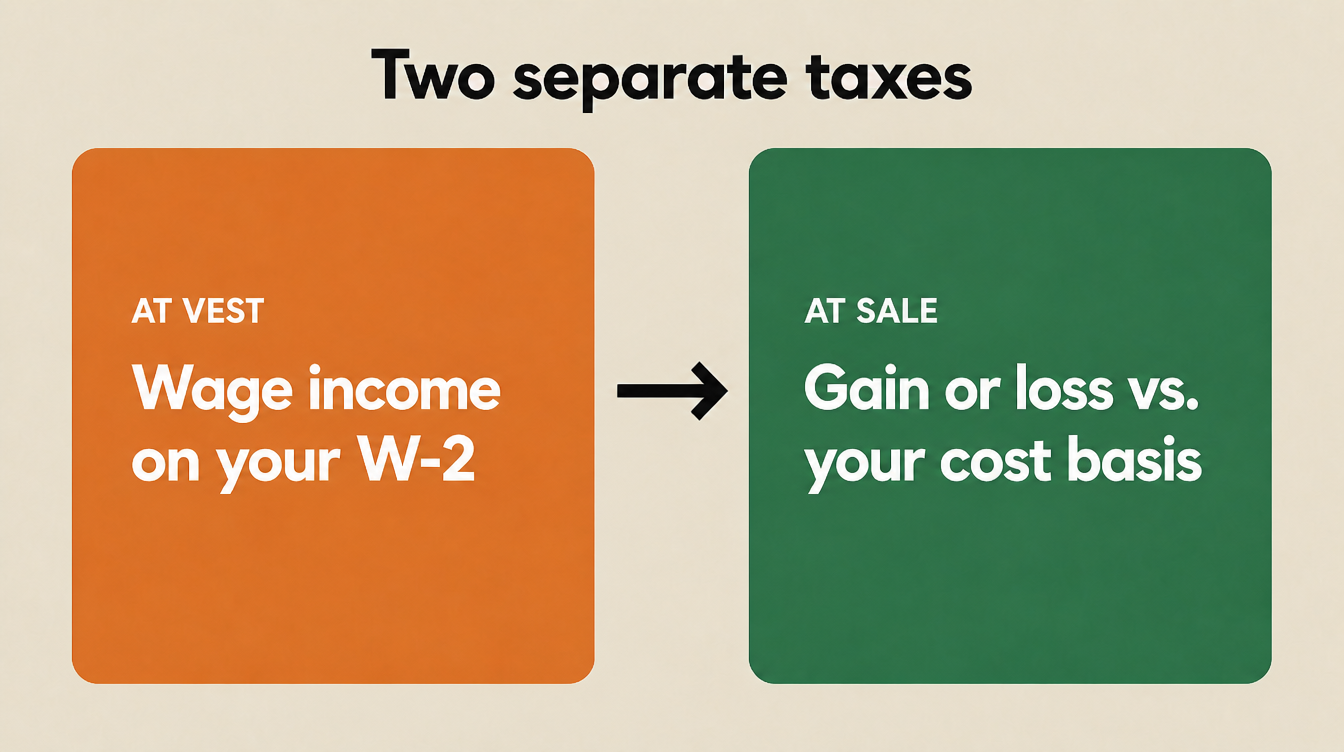
When your RSUs vest and the shares are delivered, their market value generally becomes wage income on your W-2. The value at vest becomes your cost basis. A later sale creates a separate capital gain or loss based on the difference between your sale proceeds and that original cost basis.
Standard RSU grants do not qualify for an 83(b) election because no shares are transferred at grant.
1. Check your withholding
Withholding can fall short of what you owe. Your employer may use the flat 22% federal supplemental wage rate or a method that combines the payment with regular wages. Supplemental wages above $1 million are subject to mandatory 37% withholding on the excess.
For a hypothetical example, assume $100,000 of RSU income falls in the 35% federal bracket but only 22% is withheld. The federal income-tax gap could be about $13,000 – potentially adding penalties & interest for underpayment.
You can request extra withholding on Form W-4 or make estimated payments. Payment timing matters. A late estimated payment does not necessarily erase an earlier underpayment penalty. Have your tax preparer calculate the required installments, and pay any remaining balance by the tax-payment deadline. Our safe-harbor guide explains the payment rules in more detail. This step can help prevent penalties.
2. Hold vs diversify
If the shares had arrived as cash, would you use all of that cash to buy your company's stock?
Holding should be a portfolio decision you'd defend on its own merits. For stock held one year or less after acquisition, gains are short-term and taxed at ordinary income rates, up to 37%. Hold for more than one year and gains qualify for long-term capital gains rates of up to 20%. The 3.8% net investment income tax can also apply to either type of gain, depending on your income.
If you sell soon after delivery and the sale proceeds are close to your cost basis, the additional capital gain or loss is generally small. Waiting for a lower rate means continuing to own the stock. A price decline can outweigh the tax benefit, and a large employer-stock position adds concentration risk.
Check your 1099-B against your stock-plan records before filing. The broker's reported basis may omit compensation already included on your W-2. Use the correct basis when reporting the sale on your tax return. Otherwise, you may pay more tax than necessary.
Important: follow your employer's trading restrictions before selling.
3. Max pre-tax & deferred comp
Pre-tax contributions can reduce current federal taxable income. Review these options alongside your vest calendar.
Your 401(k). The basic employee contribution limit is $24,500 for 2026, shared between pre-tax and Roth contributions. Eligible catch-up contributions may increase that limit, and plan rules can impose additional restrictions. Pre-tax contributions reduce current taxable income, with withdrawals taxable later at distribution. Roth contributions do not provide that current deduction, but are tax-free at distribution.
Your HSA. For eligible individuals, the 2026 limits are $4,400 for self-only coverage and $8,750 for family coverage, including employer contributions. Eligible people age 55 or older can contribute an additional $1,000. HSA eligibility involves more than having a high-deductible plan, and partial-year eligibility can affect the limit. Contributions may be deductible or excluded from income, earnings are federally tax-free, and withdrawals for qualified medical expenses are federally tax-free.
Deferred compensation. If your employer offers a nonqualified deferred compensation plan, you may be able to defer salary or bonus income to a later year. Elections generally must be made before the year you earn the compensation. A lower future tax rate is not assured, and payroll-tax timing can differ from income-tax timing. The deferred money generally remains an unsecured promise subject to your employer's creditors. Review the payment terms and employer risk before electing.
4. Donate stock, not cash
If you are charitably inclined, consider donating low-basis stock instead of writing a check. A gift of stock held more than one year to an eligible 501(c)(3) charity generally avoids recognizing the embedded capital gain. If you itemize, the gift may qualify for a fair-market-value deduction, subject to limits.
Long-term appreciated stock gifts are generally subject to a 30% adjusted-gross-income limit. Beginning in 2026, itemizers also face a charitable deduction floor of 0.5% of their contribution base, generally adjusted gross income. Additional limits can apply, including a restriction on the value of itemized deductions for taxpayers in the top federal bracket.
A donor-advised fund can let you make a large deductible donation in one year, without having to immediately distribute to the charity. This strategy is valuable for someone who plans on making future donations but has a high tax year and needs to maximize deductions. Bunching gifts into one year may improve the deduction, but compare the result under the 2026 rules with your tax preparer before transferring shares.
5. Tax loss harvesting
Realized losses can offset realized gains, including gains from selling employer stock. If losses exceed gains, up to $3,000 of net capital loss can offset ordinary income each year. Unused losses generally carry forward to future tax years, though using them depends on having future gains or income to offset, and any unused balance lapses at death.
Watch the wash-sale rule. Acquiring the same or substantially identical stock or securities within 30 days before or after a loss sale can disallow some or all of the current deduction. Review stock-plan share deliveries, automatic reinvestments and activity across your and your spouse's accounts, including IRAs. Replacement purchases in your IRA or Roth IRA can permanently disallow a loss.
Capital losses do not reverse RSU wage income, although the limited deduction above may reduce taxable income. Harvesting can defer taxes by lowering your replacement investments' basis, potentially creating larger gains when you sell later.
6. Direct indexing & long/short
Direct indexing means owning individual stocks to track an index, instead of owning a single index fund. Individual holdings may have losses available to harvest even when the overall index rises. For example, if the S&P 500 index is +10% for the year, that does not mean all 500 companies are up that year. In fact, in many years dozens of those companies are at a loss.
Those losses may help offset gains from diversifying employer stock, but opportunities depend on the portfolio and market conditions. Fees, differences from index returns and wash-sale limits can reduce the benefit.
Tax-aware long/short strategies combine owning shares long with short positions, to amplify loss-harvesting opportunities. The additional market exposure on both sides, long & short, can increase tax loss harvesting benefits.
Long/short strategies add borrowing costs, fees and tax complexity. Borrowing can magnify losses, and individual short positions can have theoretically unlimited losses. Tax savings are not guaranteed.
7. Exchange fund - diversify while deferring gain
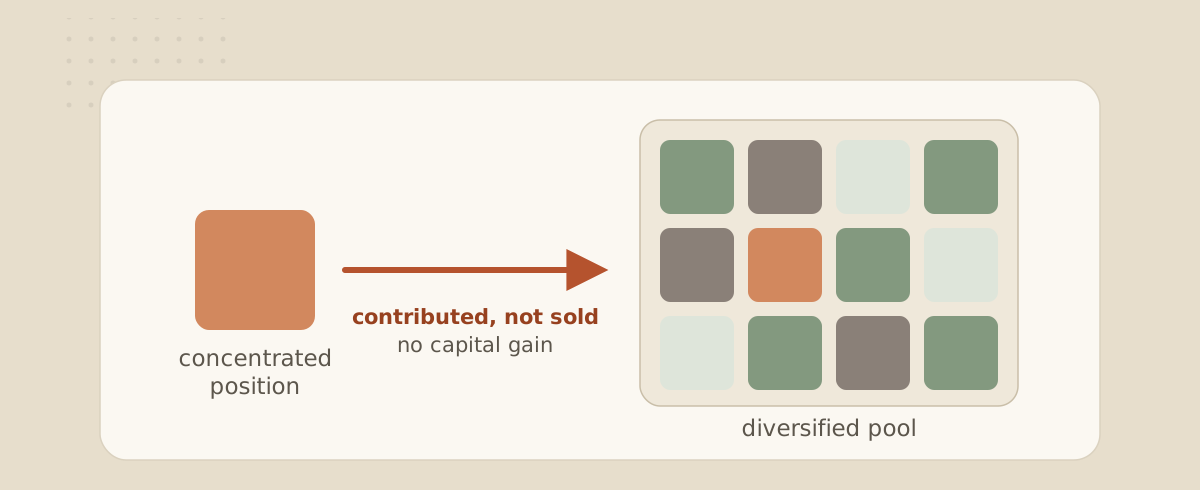
An exchange fund allows investors to diversify a position, without triggering a sale and realized gain. The fund pools contributed stock from multiple investors in a partnership. A qualifying contribution can defer capital gains while giving you exposure to a broader portfolio.
Investors should plan to hold for at least seven years to capture the tax benefits. At maturity, the fund can distribute a basket of diversified individual stocks. The original low tax basis carries through, subject to adjustments, so selling the distributed securities later can realize the deferred gain.
Eligibility, accepted stocks, fees and withdrawal terms vary by fund. Illiquidity and investment risk remain, and the tax result depends on the fund's structure and distribution terms. Our exchange-fund guide covers the structure in more detail.
These strategies are not done in isolation, and a combination may be a fit for your situation. If you'd like help reviewing the decisions around your RSU taxes, Book a call.
Disclosures: The information provided is for educational and informational purposes only and does not constitute investment, tax, or legal advice and should not be relied on as such. It is not a solicitation to buy or an offer to sell any security. It does not take into account any individual's particular investment objectives, financial situation, or needs. You should consult your own financial advisor, tax advisor, or attorney before acting on any information herein. All investing involves risk, including the possible loss of principal. Figures and tax limits referenced are for the applicable tax year and are subject to change. Valence Wealth, LLC is a registered investment advisor in the State of Arizona. Registration does not imply any specific level of skill or training.