When you exercise incentive stock options (ISOs) and hold the shares, the spread between your strike price and the fair market value generally counts as income for the alternative minimum tax, even though you sold nothing and received no cash. If the spread is large, that can mean a six-figure tax bill on a paper gain.
Model the AMT while you still have a choice about the size and timing of the exercise. This article walks through the mechanics, then runs one hypothetical from end to end so you can see where the numbers come from.
The bargain element is the whole problem
The bargain element is the difference between the fair market value of the stock on the day you exercise and the strike price you paid for it. Buy 1,000 shares at $5 when the stock trades at $35 and your bargain element is $30,000. That number drives everything that follows.
For regular tax purposes, exercising an ISO and holding the shares generally triggers no income. IRS Publication 525 treats ISOs as statutory stock options, so there's generally nothing to report on exercise for the regular calculation. That's the headline benefit, and it's real. Satisfy the holding periods in section 422(a)(1), which require no disposition within 2 years from the grant date and 1 year from the exercise date, and the entire gain can qualify for long-term capital gains rates.
The AMT however doesn't wait. Under section 56(b)(3), the deferral in section 421 simply doesn't apply for AMT purposes, so the bargain element is generally added to your income in the year you exercise. The IRS says the same thing plainly in Topic 427 on stock options. You now have two parallel tax calculations: the regular one, which ignores the exercise, and the AMT one, which picks it up. You pay whichever produces more tax.
You can owe real tax on a gain that exists only on paper, in shares you can't or won't sell yet. That's the trap. The stock can fall after year-end, and the AMT bill you already triggered doesn't fall with it.
What changed for 2026
- Exemption: $90,100 for single filers, $140,200 for married filing jointly.
- Phaseout begins: $500,000 of AMTI for single filers, $1,000,000 for married filing jointly, thresholds lowered from the prior year.
- Phaseout rate: 50 cents of exemption lost per dollar of AMTI above the threshold, up from 25 cents under prior law.
- Rates: 26% on the first $244,500 of taxable excess and 28% above it ($122,250 for married filing separately).
- Effect: the faster phaseout raises the marginal cost of an ISO exercise inside the phaseout range to roughly 42 cents per dollar of bargain element.
How the 2026 Alternative Minimum Tax (AMT) is Calculated
The AMT is a second tax calculation run alongside the regular one. It starts from a broader income base, subtracts an exemption that shrinks at higher incomes, applies two rates to produce a tentative minimum tax, and compares that result to your regular tax. If the tentative minimum tax is higher, you pay the difference.
- AMT income (AMTI). Your income recomputed under the AMT rules, with certain items added back. For equity comp, the ISO bargain element is usually the large one, reported on line 2i of Form 6251.
- The exemption. For 2026 the IRS set the exemption at $90,100 for unmarried filers and $140,200 for joint filers, per the 2026 inflation adjustments. These change every year, so pull the current figures rather than reusing last year's.
- The phaseout. The exemption begins to phase out at $500,000 of AMTI for unmarried filers and $1,000,000 for joint filers, and section 55(d) now reduces it by 50 cents for every dollar above that threshold, up from 25 cents under prior law. At high incomes the exemption can reach zero.
- The rates. 26% and 28%, with the 28% rate applying above $244,500 of taxable excess for 2026. The result is your tentative minimum tax.
One mechanical point that matters in practice. An ISO exercise generally produces no wages and no federal income tax is withheld from you at exercise, so nothing is set aside to cover the AMT. The liability shows up when your return is prepared, and depending on the size of the shortfall, an underpayment-of-estimated-tax penalty can also apply. For a meaningful block, mapping the estimated payments and safe harbor at the same time is one way people handle it.
A worked hypothetical
Here's a rounded hypothetical for illustration only, and not a depiction of any actual client or outcome. Maya is a senior engineer at a public company. She files single, and her taxable income before any exercise is $500,000. She holds 20,000 vested ISOs with a $5 strike. The stock trades at $35. She's considering exercising all of them in one year and holding the shares.
| Line | Amount |
|---|---|
| ISOs exercised | 20,000 |
| Strike price | $5 |
| Fair market value at exercise | $35 |
| Cash required to exercise | $100,000 |
| Bargain element (AMT adjustment) | $600,000 |
| Taxable income before exercise | $500,000 |
| Regular federal tax on $500,000 (2026 single brackets) | ≈ $143,800 |
| AMT income (simplified as taxable income plus the bargain element) | $1,100,000 |
| AMT exemption (fully phased out at this AMTI) | $0 |
| Tentative minimum tax (26% on the first $244,500, 28% above) | ≈ $303,100 |
| AMT owed on top of regular tax | ≈ $159,300 |
Two assumptions are doing work in that table. Maya's whole $500,000 of pre-exercise income is treated as taxable income under the 2026 single brackets, where the top slice sits in the 35% marginal bracket. And AMTI is simplified as taxable income plus the bargain element, when real AMTI starts from a different base and adds back items such as the state and local tax deduction. Both would move the answer somewhat.
Now look at the cash flow. Maya writes a $100,000 check to exercise, then owes roughly $159,300 in additional federal tax the following April. Call it $259,300 out the door against zero shares sold and zero dollars received. If the stock holds at $35, she's holding $700,000 of stock and the trade may work out well, with future appreciation potentially taxed at long-term rates once the holding periods are met. If the stock drops to $12 after year-end, the AMT triggered in the exercise year was still based on the $35 exercise-date value. A same-year sale can change that result, as described below.
These figures are illustrative and rounded, and your result could differ. The real calculation depends on the current year's brackets, exemption, and phaseout thresholds, on state tax, and on everything else in the return. The shape of the problem is the takeaway: a large bargain element stacked on a high income can generally produce AMT in the six figures.
Where the regular tax figure comes from
The $143,800 is the ordinary tax on $500,000 of taxable income, run through the 2026 single-filer brackets in Revenue Procedure 2025-32: 10% on the first $12,400, 12% to $50,400, 22% to $105,700, 24% to $201,775, 32% to $256,225, and 35% on the rest. That comes to $143,769, rounded here to $143,800. The exercise itself never enters this calculation, which is the point: section 421 keeps it out of regular taxable income, and only the AMT column picks it up.
The tentative minimum tax then runs on the AMT side. AMTI of $1,100,000 is far above the $500,000 phaseout threshold, and at 50 cents of exemption lost per dollar over that line the $90,100 exemption is gone well before $1,100,000, so the full AMTI is taxed: 26% on the first $244,500 and 28% on the remaining $855,500, or $303,110. The AMT you actually owe is the difference between the two columns, $303,110 less $143,769, about $159,300.
A second hypothetical, where no AMT is due
Here's a rounded hypothetical for illustration only, and not a depiction of any actual client. Not every exercise triggers AMT. The exemption absorbs a meaningful bargain element as long as AMTI stays under the phaseout threshold.
| Line | Amount |
|---|---|
| ISOs exercised | 1,500 |
| Strike price | $5 |
| Fair market value at exercise | $35 |
| Cash required to exercise | $7,500 |
| Bargain element (AMT adjustment) | $45,000 |
| Taxable income before exercise | $200,000 |
| Regular federal tax on $200,000 (2026 single brackets) | ≈ $40,600 |
| AMT income (taxable income plus the bargain element) | $245,000 |
| AMT exemption (no phaseout below $500,000 of AMTI) | $90,100 |
| AMT taxable base | $154,900 |
| Tentative minimum tax (26%, base under $244,500) | ≈ $40,300 |
| AMT owed on top of regular tax | $0 |
Same strike, same share price, same spread per share. The only differences are the size of the block and the income underneath it. Here the tentative minimum tax of about $40,300 lands just below the regular tax of about $40,600, so nothing extra is due. Exercise roughly 40 to 50 more shares and the two columns cross, which is exactly what the next section measures.
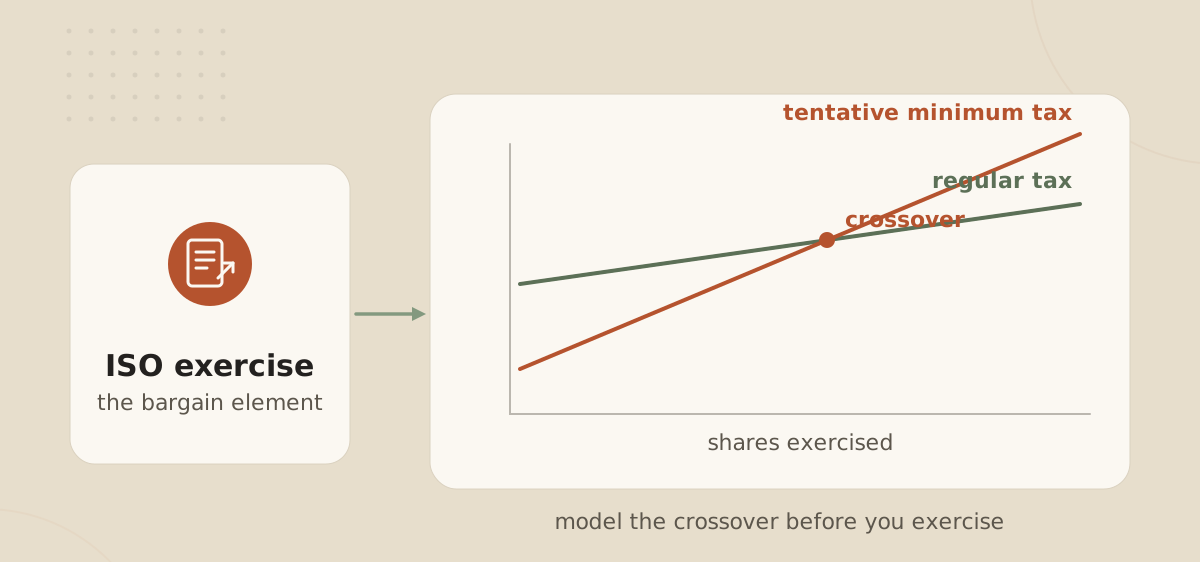
The crossover point: how much can you exercise without AMT?
Your crossover point is the amount of bargain element you can recognize in a year before your tentative minimum tax passes your regular tax. Below that line, exercising generally adds no federal AMT for the year, though you still pay the strike price in cash and state tax can apply. Above it, every additional dollar of spread starts adding AMT. It's the single most useful number in ISO planning.
The cost above the line is steeper than the headline rates suggest. Inside the exemption phaseout range, each extra dollar of AMTI adds a dollar of taxable excess and strips 50 cents of exemption, so a dollar of bargain element can add roughly 42 cents of AMT rather than 28. Once the exemption reaches zero, the marginal cost settles back toward 28 cents.
The crossover is personal. It moves with your salary, your deductions, your filing status, and the year's AMT parameters. In Maya's hypothetical her regular tax exceeds her tentative minimum tax before the exercise, but the gap is roughly $34,000, which at about 42 cents on the dollar covers only about $80,000 of bargain element, near 2,700 of her 20,000 options. Roughly 13% of the grant.
That reframes the decision. A question that sounded binary (exercise or don't) becomes a dial: how many shares this year, how many in January, how many the year after. Spreading a large exercise across two or three tax years is one option people commonly use, and it can reduce or eliminate the AMT in any single year. Which approach fits your situation is a conversation for your tax professional.
Timing details worth knowing
Early-year exercises leave more room to react
Exercise in January and you have roughly 11 months to watch the stock before the year closes. If the price collapses, a sale before December 31 of the exercise year is generally a disqualifying disposition, and section 56(b)(3) provides that where the disposition and the inclusion fall in the same taxable year, no AMT adjustment is generally required. The Form 6251 instructions state it directly: sell in the year of exercise and the regular tax and AMT treatment are generally the same. That escape hatch exists only inside the calendar year of exercise.
A small spread means a small problem
AMT cost scales with the bargain element, so exercising when the spread is narrow, sometimes shortly after grant where the plan permits early exercise, can shrink the exposure before it builds. That path carries its own trade-offs, starting with cash at risk in an unproven company. Early-exercising unvested ISOs adds another wrinkle. For AMT purposes the adjustment generally occurs when the shares vest, unless you make a timely section 83(b) election for AMT purposes within 30 days of the stock transfer. That election generally is not effective for regular income tax purposes while the ISO rules under section 421 apply.
Stress-test a market drop
Any exercise-and-hold plan is worth testing against the scenario where the shares lose half their value before you can sell. FINRA describes concentration risk as the risk of amplified losses from holding a large portion of your assets in one investment, and employer stock is a common way it builds. Concentrated positions carry the risk of significant loss, and the AMT does not refund itself when that happens.
Dual basis: why one exercise leaves you tracking two numbers
After an exercise that triggered AMT, the same shares carry two different cost bases. For regular tax, your basis is generally what you paid, $5 per share in Maya's case. For AMT purposes, section 56(b)(3) determines basis using the AMT treatment, so your AMT basis is generally the $35 value used to compute the adjustment.
That gap matters when you sell. The regular calculation sees a gain measured from $5. The AMT calculation sees a smaller gain measured from $35, and the difference shows up as a negative adjustment in the sale year. The Form 6251 instructions tell you to increase your AMT basis by the amount of the adjustment, which is the part people lose track of years later.
Track both numbers from day one. Your broker generally reports the regular basis, while the AMT basis lives in your own records alongside the Form 3921 your employer files for each ISO exercise. If that record goes missing, you could end up paying tax on the same spread twice.
Credit recovery: the AMT you pay is often a prepayment
AMT triggered by an ISO exercise is generally a timing difference, and timing-difference AMT usually generates a minimum tax credit that can offset regular tax in later years. You claim it on Form 8801, and the unused portion generally carries forward indefinitely.
Two honest caveats. Recovery can be slow, because section 53 caps the credit each year at the amount by which your regular tax exceeds your tentative minimum tax. Someone who exercises ISOs every year may keep re-triggering AMT and rarely open that window at all. And the credit is a federal mechanism, so state treatment varies; whether your state runs its own minimum tax, and whether it offers a parallel credit, is a question for your own return.
So the check Maya writes could well come back over time. Coming back over several years in pieces is a different thing from a refund, and none of it is guaranteed.
Key numbers
- AMT rates: 26% and 28%, on a parallel income base that includes the ISO bargain element.
- 2026 exemption: $90,100 unmarried, $140,200 joint, phasing out at 50 cents per dollar above $500,000 and $1,000,000 of AMTI.
- ISO holding periods for long-term treatment: 2 years from grant, 1 year from exercise.
- In the hypothetical: $600,000 of bargain element produced roughly $159,300 of AMT with no shares sold.
- Cash out the door in the hypothetical: roughly $259,300, exercise cost plus AMT.
- Escape hatch deadline: a same-year sale before December 31 generally removes the AMT adjustment.
- Bases to track per lot: 2, regular and AMT, plus the Form 8801 credit carryforward.
What to model before you exercise
Before exercising a meaningful ISO block, you or whoever runs your projection should be able to answer these questions with numbers, using current-year figures:
- Your crossover point: how much bargain element fits under your regular tax this year.
- The full AMT bill at each size you're considering, including state tax.
- The downside case: the cash consequences if the stock falls 50% after exercise, and what a same-year sale would and would not undo.
- The multi-year version: what splitting the exercise across two or three years changes.
- The recovery path: when the minimum tax credit could plausibly come back, given your income pattern.
None of this is exotic. It's a spreadsheet and an afternoon, or one planning session with someone who runs the calculation regularly. Skipping it is the version that can get expensive. If you'd like a second set of eyes before you exercise, start with a conversation. The planning is billed as a published flat annual fee, and you can check what that works out to before you talk to anyone. If your equity is a mix of ISOs, RSUs, and an ESPP, the walkthrough of how those pieces interact covers the rest of the stack.
Common questions
Do I owe AMT if I exercise and sell the same day?
Generally no. Section 56(b)(3) provides that where the disposition and the AMT inclusion fall in the same taxable year, the ISO adjustment drops out, and the Form 6251 instructions confirm that regular tax and AMT treatment are generally the same when you dispose of the stock in the year you exercised. What you get instead is a disqualifying disposition: the spread is generally taxed as ordinary compensation income, with no long-term capital gains treatment on that portion. You've traded one tax problem for another, and which one is preferable depends on your full picture.
Will I get the AMT back?
Often, over time, in pieces, and never on a guaranteed schedule. AMT from an ISO exercise generally creates a minimum tax credit claimed on Form 8801 that carries forward indefinitely, but section 53 limits how much you can use in any year to the excess of your regular tax over your tentative minimum tax. If you keep exercising ISOs, that excess may not appear for years. Treat the credit as a maybe with an unknown date, and model the cash outlay as real money leaving now.
How many ISOs can I exercise without triggering AMT?
Up to your crossover point, which is personal and has to be calculated from your own return. It depends on your salary, filing status, deductions, and the year's exemption and phaseout figures, and there is no rule of thumb that survives contact with a real tax return. In the hypothetical above, the headroom worked out to roughly 2,700 of 20,000 options for one high earner in one year. Someone else's number could be zero, or all of them. The calculation itself is straightforward, which is why it's worth running before you exercise rather than in April. Planning around equity comp is a large part of what we do.
Is any tax withheld when I exercise ISOs?
Generally no. An ISO exercise produces no wages for income tax withholding purposes, so no federal income tax comes out and nothing is set aside toward the AMT. The liability first appears when the return is prepared, and an underpayment-of-estimated-tax penalty can apply on top of it. Whether to size estimated payments alongside the exercise is a conversation for your tax professional.
How do I track cost basis after an ISO exercise that triggered AMT?
Keep two numbers per lot. For regular tax, your basis is generally what you paid for the shares. For AMT, section 56(b)(3) determines basis using the AMT treatment, so your AMT basis is generally the fair market value used to compute the adjustment, and the Form 6251 instructions direct you to increase your AMT basis by the amount of that adjustment. Your broker generally reports only the regular basis, so keep the Form 3921 your employer files for each exercise alongside your own record of the AMT figure.