Amazon's 401(k) has a headline number and a hidden one. The headline - a 50% match on your first 4% of pay, with a 3-year wait before it's yours. The hidden number is $72,000, the total the plan can shelter for 2026 once you switch on after-tax contributions and Roth conversion. That combination (commonly called the Mega Backdoor Roth) is the feature that's easiest to overlook. Here's the whole machine.
The employer match
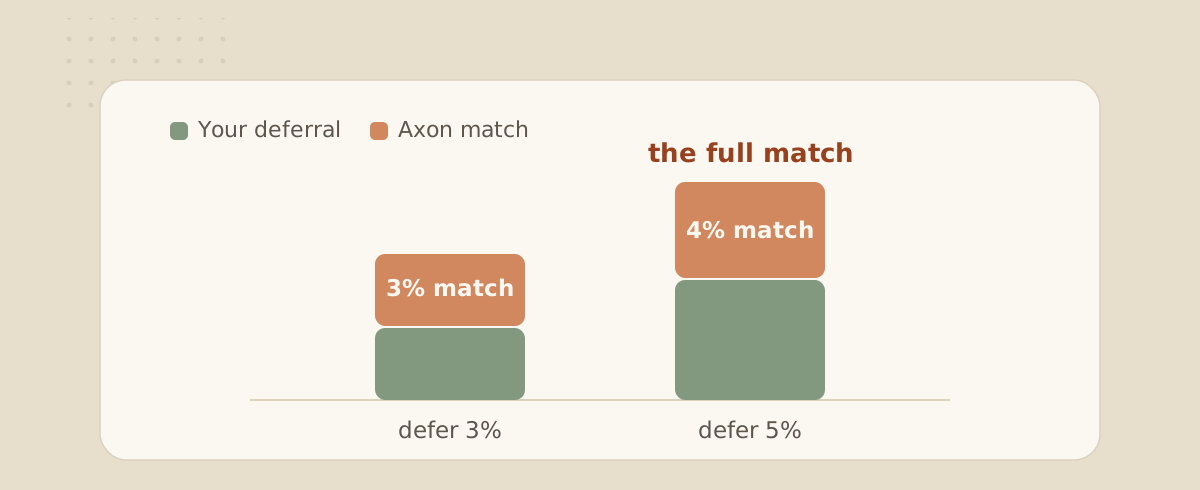
For every dollar you contribute up to 4% of your eligible pay, Amazon contributes 50 cents. Contribute 4% and you collect the full match - 2% of your eligible pay. Contribute less and you leave part of it uncollected. On a hypothetical $200,000 of eligible pay, the full match is worth about $4,000 a year.
Two details shape the real value. The match runs on eligible pay as the plan defines it, which is generally your cash compensation - RSU income generally doesn't count toward it. And a habit worth building: spread your contributions so a matched percentage comes out of every paycheck through December, rather than front-loading so hard that your deferrals stop mid-year.
The 3-year vesting cliff
Your own contributions are always yours. The match is different - it vests all at once after three years of vesting service, and before that, none of it is yours. Leave in year two and the matched dollars are forfeited.
The planning consequence is blunt - until year three, treat the match as a bonus you might collect, not a balance you own. If you're weighing an offer elsewhere inside your first three years, the unvested match belongs on the list of things you'd walk away from, right next to unvested RSUs.
2026 IRS limits
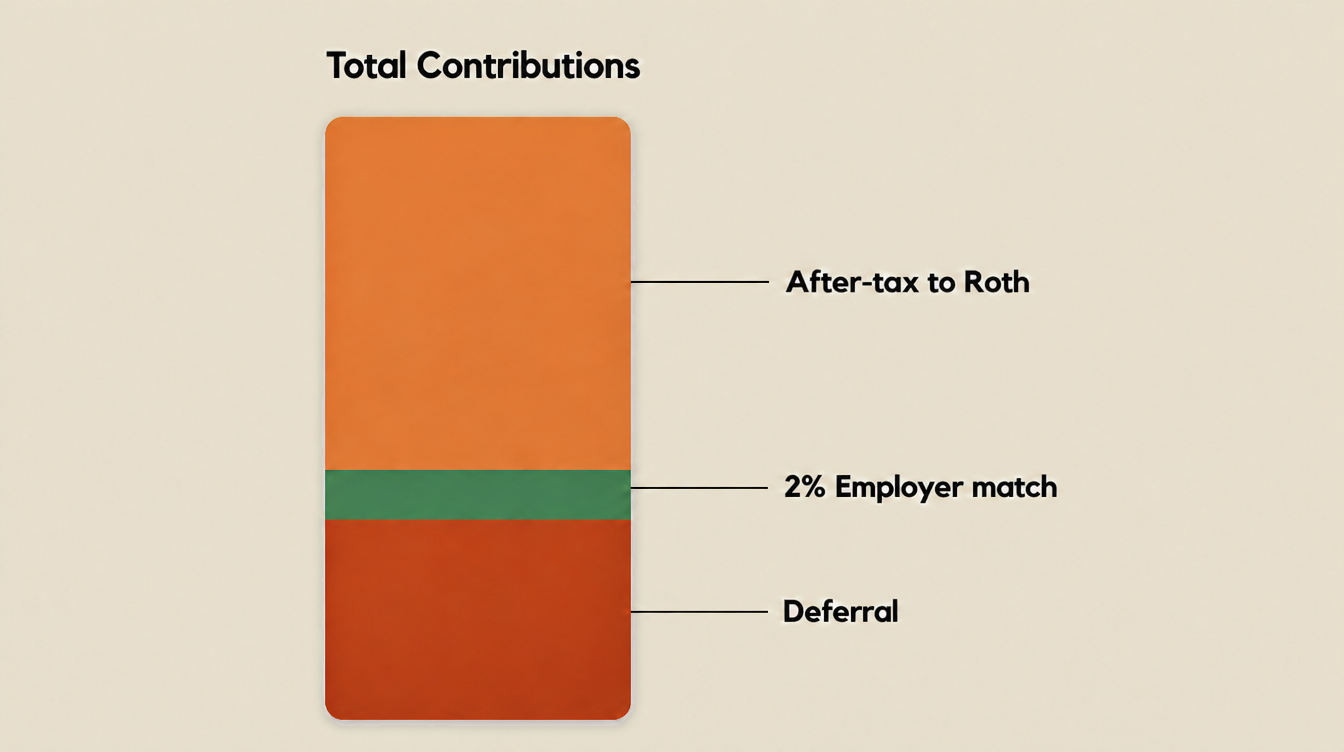
For 2026, the IRS limits cap contributions at several levels. You can defer up to $24,500 of your own pay, plus an $8,000 catch-up beginning the year you turn 50, or $11,250 instead if you're 60 to 63 and the plan allows it. The number that matters most for this article is the total limit - $72,000 for 2026, covering your deferrals, Amazon's match, and after-tax contributions combined. Catch-up contributions sit on top of that total, not inside it.
One 2026 change catches senior employees: under the SECURE 2.0 Roth catch-up rule, catch-up contributions generally must be made as Roth if your prior-year Amazon wages topped $150,000. The regular $24,500 can stay pre-tax - the catch-up generally can't.
Pre-tax vs Roth vs After-tax
Amazon's plan takes contributions three ways - pre-tax, Roth, and after-tax. Pre-tax dollars skip today's taxes and get taxed at distribution in retirement. Roth dollars are taxed now, and qualified withdrawals come out federal-tax-free later. The right split depends on your tax bracket today versus your bracket in retirement. In a big vest year, RSU income can push you into the 32% to 37% brackets - that tilts the math toward pre-tax for your deferrals. The third bucket, after-tax, is not the same as Roth - and it's the doorway to the strategy below.
Mega Backdoor Roth, step by step
The strategy stacks three plan features into one result - a much bigger Roth balance than the normal limits allow.
Step 1. Max your regular deferrals - $24,500 for 2026 - and capture the full match.
Step 2. Turn on after-tax contributions. These sit above the $24,500 deferral limit and fill the space up to the $72,000 total cap. You can view your current contribution elections and available room on your Fidelity 401(k) benefits page.
Step 3. Turn on the automatic Roth conversion - the step that's easy to miss. Switching on after-tax contributions and stopping there leaves the strategy half-built. Without the conversion, after-tax money sits in the account building up taxable earnings - it grows tax-deferred, not tax-free. The conversion election lives in your Fidelity account. Confirm it's available and switched on as automatic, so after-tax dollars move to Roth the moment they arrive.
Step 4. Repeat every year. The conversion itself is generally not taxable when it happens immediately, because the contributions were already taxed and there are no earnings yet to tax.
A $250,000 hypothetical
Let's take a look at an example, using 2026 figures, for an employee under 50 with $250,000 of eligible pay who maxes everything, one step at a time:
- Regular deferrals: $24,500
- Amazon's match at 2% of pay: $5,000
- Used so far: $29,500 of the $72,000 total limit
- Room remaining for after-tax contributions: $72,000 - $29,500 = $42,500
- That $42,500 converts to Roth - on top of the normal limits
Run the same math at your own pay and deferral rate before assuming the room is there - the numbers shift with the match and any catch-up.
Your 401(k) & RSUs
At Amazon, the 401(k) is the quiet half of a compensation package where RSUs make the noise. The two work best when they're planned together. A big vest year raises your marginal rate, which strengthens the case for pre-tax deferrals. The vest calendar also raisesestimated-tax questions that the 401(k) alone won't solve. And your 401(k) is usually the easiest place in your financial life to stay well diversified - your paycheck and unvested grants already ride on Amazon stock.
Common questions
How much does Amazon match on the 401(k)?
50% of what you contribute, up to 4% of eligible pay - a maximum match of 2% of pay. Contribute at least 4% to collect all of it.
When does the Amazon 401(k) match vest?
All at once after three years of vesting service. Before that, the match is not yours, and leaving early forfeits it. Your own contributions are always 100% yours.
Does Amazon's 401(k) allow the mega backdoor Roth?
The plan permits traditional after-tax contributions - the first ingredient. The second, an in-plan Roth conversion election, lives in your Fidelity account. Confirm it's available and on before you rely on the math, since plan features can change.
What happens to my 401(k) if I leave Amazon before three years?
Your contributions, their growth, and any rollovers leave with you. The unvested match is forfeited. If you're close to the three-year mark, the vesting date is worth checking before you pick a start date somewhere else.
Is the mega backdoor Roth worth it if I can't max everything?
The order of operations matters more than the total. Capture the full match first, then fund the deferral limit, and only then does after-tax territory open up. If cash flow stops at the match, capturing all of it is still the right first priority.
Get every dollar
Amazon employees tend to plan around May and November and let the 401(k) run on defaults the rest of the year. A ten-minute review - match captured, deferral rate on pace, after-tax and conversion elections on - is ten minutes well spent. If you'd like a second set of eyes on how the 401(k), the vest calendar, and the tax bill fit together, tell us a little about your situation and we'll set up some time to talk.
Valence Wealth is an investment adviser registered in the State of Arizona. Valence Wealth is not affiliated with, endorsed by, or compensated by Amazon.com, Inc., Fidelity Investments, or any fund company, and Amazon has not reviewed or approved this content.
Disclosures: The information provided is for educational and informational purposes only and does not constitute investment, tax, or legal advice and should not be relied on as such. It is not a solicitation to buy or an offer to sell any security. It does not take into account any individual's particular investment objectives, financial situation, or needs. You should consult your own financial advisor, tax advisor, or attorney before acting on any information herein. All investing involves risk, including the possible loss of principal. Figures and tax limits referenced are for the applicable tax year and are subject to change. Valence Wealth, LLC is a registered investment advisor in the State of Arizona. Registration does not imply any specific level of skill or training.
Plan features described reflect publicly available information as of the date of publication. Amazon can amend its plan at any time, and the plan's official documents govern.
Sources
- Amazon.jobs: U.S. benefits overview (401(k) match, vesting, contribution types)Amazon.jobs
- IRS: 401(k) limit increases to $24,500 for 2026 (IR-2025-111)Internal Revenue Service
- IRS: final regulations on the SECURE 2.0 Roth catch-up ruleInternal Revenue Service
- IRS: COLA increases for dollar limitations on benefits and contributionsInternal Revenue Service
- DOL EFAST2: Amazon 401(k) Plan Form 5500 filings (recordkeeper and participant data)U.S. Department of Labor
- Levels.fyi: Amazon 401(k) match overviewLevels.fyi