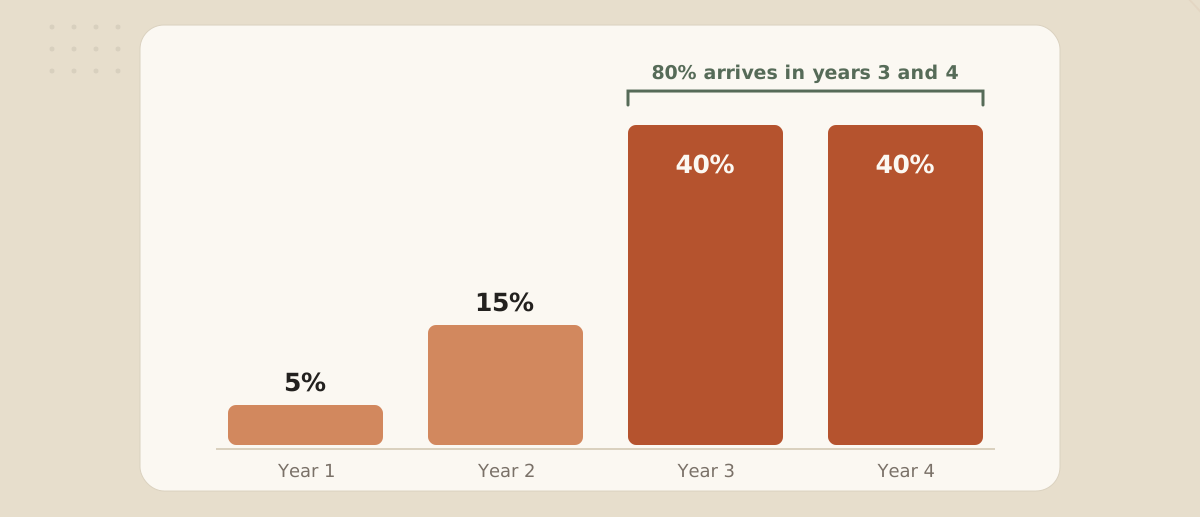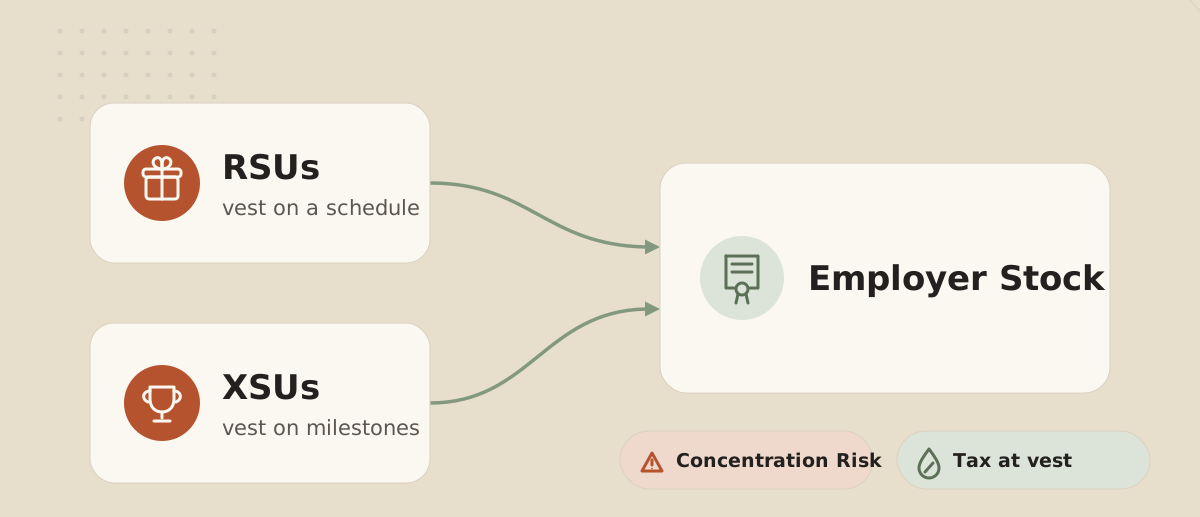
Amazon RSUs have a way of piling up. There's the grant you received when you were hired, then any new grants from the annual compensation review, each vesting on its own schedule. A few years in, it's easy to own far more Amazon stock than you'd ever have chosen to buy with cash.
That stockpile can build real wealth, and it can also lose value if the stock falls. It also complicates things. A growing share of your net worth rides on one company, the timing of each vest starts to matter, and the tax picture gets more layered with every new lot. The good news is that the income from a vest is locked in by the time you can sell, so what's left is an investment decision about how much Amazon you want to own. The framework below walks through that decision in six steps.
A primer on how Amazon RSUs are taxed
When your RSUs vest, the market value of the shares counts as wages and shows up on your W-2, the same way a cash bonus would. Nothing is taxed at grant. Under the IRS rules, property you receive for your work becomes income once it has vested, and that's true whether you sell the shares that afternoon or hold them for a decade.
Two things are set on vest day. Your cost basis is established at the vest-day value, because it reflects the amount included in your income. Your holding period clock starts as well. Hold for more than one year from there and any further gain is long-term, and one year or less makes it short-term.
Here's how that plays out on a hypothetical example vest of 200 shares at $250, or $50,000 of W-2 income.
| What you do | Sale price | Gain or loss vs. basis | How that piece is taxed |
|---|---|---|---|
| Sell on vest day | $250 | About $0 | Little or no cap gain |
| Sell 8 months later, stock is up | $290 | +$8,000 | Short-term capital gain |
| Sell 14 months later, stock is up | $290 | +$8,000 | Long-term capital gain |
| Sell 8 months later, stock is down | $210 | -$8,000 | Short-term Capital loss |
The $50,000 doesn't appear in that table because it was taxed as wages in every scenario. Selling at vest generally adds little or no further tax, and waiting a year for long-term treatment only helps the growth after vest. You'd be carrying twelve months of single-stock risk to get a better rate on a gain that may or may not show up.
Watch the withholding. Many employers withhold federal income tax on RSU income at the flat 22% supplemental rate (2026, and 37% on supplemental wages above $1 million). On our hypothetical $50,000 vest, that's $11,000. If that income actually lands in the 35% federal bracket, the federal income tax could be closer to $17,500, and the roughly $6,500 difference may be yours to cover. State tax, where it applies, would add to that. Selling doesn't cause that gap and holding doesn't avoid it, though selling does hand you the cash to cover it. Our RSU tax gap calculator estimates your own number, the Amazon RSU guide walks through how Amazon vests hit your W-2, and the safe harbor rules explain how to stay clear of an underpayment penalty.
1. Count everything you have riding on Amazon
Your vested shares are one piece of your Amazon exposure, and they're the only piece you can change today. Your salary, next promotion, benefits, and job security all depend on how the company does. Your unvested RSUs move with the stock every day.

Take a hypothetical household with a $2,500,000 net worth.
| Piece | Amount | Share of net worth |
|---|---|---|
| Vested RSUs | $600,000 | 24% |
| Unvested RSUs | $500,000 | Not counted in net worth |
| Amazon-linked total | $1,100,000 |
Suppose, purely as an illustration and not a forecast, the stock fell by half. The vested shares alone would take about 12% off this household's net worth, and the unvested RSUs would lose half their value at the same moment. A falling stock price and a tougher job market at the same company can show up together, which is the risk of stacking both on one employer. Concentrated positions carry the risk of significant loss. The test is whether your financial plan depends on how one stock performs.
2. Run the cash bonus test
With the vest income locked in, a simple exercise makes the investment decision easier to see. Picture the vest arriving as an cash bonus instead. After setting aside the taxes, decide how much of what remained you'd use to buy Amazon stock, and how much would go toward a house, your cash reserves, your kids’ college savings, or your retirement.
Some people would put a good share of that cash into Amazon, and that's a legitimate answer. Plenty of people wouldn't put an entire bonus into any single company. Yet holding vested shares is much the same decision with the steps removed. You already own the stock, so doing nothing feels neutral, but economically, holding works a lot like buying. Keeping a vest is similar to taking that after-tax cash and choosing to buy Amazon.
3. Set a concentration threshold
A target turns every vest into a quick check instead of a fresh debate. One common approach is to cap Amazon at a set percentage of your investable net worth. There's no universally right percentage. "Amazon is 10% of our investments and we're comfortable there" is an investment decision.
Holding some Amazon can be perfectly reasonable, especially when it's a deliberate slice, when you have substantial assets outside the company, or when a long time horizon makes single-stock risk easier to carry. You also don't have to be bearish on Amazon to diversify. A common objection is "I don't want to sell because I think the stock is going higher." Maybe it is. I don't know, and neither does anyone else. You can believe Amazon has an excellent future and still decide you already own enough of it, because nobody knows what happens next and there's a limit to how much of your financial future should ride on being right.
Diversifying does not guarantee a better result or protect against loss. If Amazon rises after you sell, you give up that gain. That is the trade you are making.
4. If you sell, choose which shares go first
If you've been at Amazon for a while, you probably own shares from many different vests, and they aren't the same for tax purposes. Picture two hypothetical lots, each worth $200,000 today.
| Old RSUs | New RSUs | |
|---|---|---|
| Value today | $200,000 | $200,000 |
| Cost basis | $40,000 | ~$200,000 |
| Gain if you sell | $160,000 | ~$0 |
Both sales reduce your Amazon exposure by the same $200,000. One comes with a $160,000 taxable gain and the other comes with almost none. If you've decided to bring your concentration down, new vests can work like a release valve, a chance to keep your concentration from growing without touching the shares that are expensive to sell. If your brokerage account sells the oldest shares first by default, look for the setting that lets you choose specific lots.
The older, low-basis shares call for different tools. If you decide to reduce them, spreading sales across tax years may help manage the tax cost. If you itemize, a gift low-basis RSUs held more than one year to a public charity can be deducted at fair market value, subject to AGI limits and other rules, while shares held one year or less are limited to your basis. For someone who already gives, that makes the long-held, low-basis lots generally the more tax-efficient shares to donate, and fresh vests generally the cheaper ones to sell. For some investors, an exchange fund is another route, though Amazon's policy restricts these for some employees. Our piece on managing RSU taxes covers each of these.
Be careful selling anything at a loss. The wash sale rule disallows a loss if you acquire substantially identical stock within 30 days before or after the sale. With quarterly vests, new Amazon shares may land inside that window, so check with your CPA before counting on the loss.
5. Follow Amazon's trading rules
Amazon's Insider Trading Policy is public. It's filed as an exhibit to the annual report, and several parts of it bear directly on when and how you can act.
- Nobody trades on material nonpublic information. That applies to every employee, in or out of a trading window.
- Trading windows. Insiders can trade only during a window. Windows generally open after each quarterly earnings release and run for a few weeks.
- Preclearance. Level 10 and above, plus others Legal identifies, need approval before any transaction in Amazon securities.
- Elections count as trades. Making or changing a "sell-all" or tax election is a covered transaction, and so is adopting or amending a Rule 10b5-1 trading plan. If you want your vests sold automatically, set that up when your window is open.
- Hedging is restricted. Directors, Section 16 officers and employees at Level 11 and above, and people in their households, may not enter into any speculative, hedging or derivative transaction that primarily involves or references Amazon securities. The policy names prepaid variable forwards, equity swaps, collars and exchange funds as examples. Others covered by the guidelines need preclearance from Legal first.
6. Revisit the plan once a year
Amazon's annual report says most awards are granted at hire or in Q2 as part of the annual compensation review, which makes Q2 a natural checkpoint. Each year, update the numbers from step 1, rerun the cash bonus test with that year's vests in mind, and check whether your target still fits your plan.
Putting the framework together
This framework is a starting point, not a recommendation. Neither the six steps nor this table can tell you whether to sell or hold Amazon or any other stock. The rows aren't weighted and can conflict, neither knows your full situation or where the stock is headed.
| Question | May point toward reducing the position | May point toward keeping the position |
|---|---|---|
| What % of your net worth is tied to Amazon? What is your concentration threshold? | Above the level you'd choose on purpose | At or below a level you chose on purpose |
| How much unvested Amazon is still coming? | Large vests ahead - more stock arrives whether you sell or not | Little left to vest |
| Does the family have cash needs in the coming years? | A home purchase, tuition, a tax gap to cover | Covered from salary and savings |
| What is the tax basis for the shares in question? | Fresh vests, basis near the vest date price | Old lots with large gains you'd rather stage, gift or exchange |
| Are you charitably inclined? | None | You give regularly and may donate long-held, low-basis shares |
Questions to weigh, not a recommendation. Educational only.
Plan around the vest calendar
Once you've picked your number, the work is sticking to it vest after vest. If you'd like help setting that number and building a selling plan around your own vest schedule, tell us a little about your situation and we'll set up some time to talk.
Disclosures: Valence Wealth is an investment adviser registered in the State of Arizona. Valence Wealth is not affiliated with, endorsed by, or compensated by Amazon.com, Inc., and Amazon has not reviewed or approved this content.
The information provided is for educational and informational purposes only and does not constitute investment, tax, or legal advice and should not be relied on as such. It is not a solicitation to buy or an offer to sell any security. It does not take into account any individual's particular investment objectives, financial situation, or needs. You should consult your own financial advisor, tax advisor, or attorney before acting on any information herein. All investing involves risk, including the possible loss of principal. Figures and tax limits referenced are for the applicable tax year and are subject to change. Valence Wealth, LLC is a registered investment advisor in the State of Arizona. Registration does not imply any specific level of skill or training.
Compensation program features described reflect publicly available information as of the date of publication. Amazon can change its programs at any time, and your grant agreement and plan documents govern. References to Amazon.com, Inc. stock illustrate equity compensation concepts and are not a recommendation to buy, sell or hold that or any security. All share prices, dollar amounts and households shown are hypothetical, do not reflect actual results or any client's experience, and are not a forecast. Valence Wealth, its owner and its clients may hold positions in Amazon.com, Inc. stock. The summary of Amazon's Insider Trading Policy paraphrases a publicly filed document, is not complete, and Amazon's current internal policy and Legal Department govern. Valence Wealth is not a CPA firm or a law firm.
Sources
- IRS Publication 525: taxable and nontaxable income (restricted property)Internal Revenue Service
- 26 CFR 1.83-4: holding period and basis of property received for servicesCornell Legal Information Institute
- IRS Publication 550: investment income and expenses (holding period and wash sales)Internal Revenue Service
- Instructions for Form 8949: sales and other dispositions of capital assets (adjusting an incorrect basis)Internal Revenue Service
- IRS Publication 526: charitable contributions (capital gain property)Internal Revenue Service
- IRS Publication 15: supplemental wage withholding ratesInternal Revenue Service
- Amazon.com, Inc. Form 10-K, year ended December 31, 2025 (RSU vesting terms and grant timing)U.S. Securities and Exchange Commission
- Amazon.com, Inc. Insider Trading Policy, Exhibit 19.1 to Form 10-K for the year ended December 31, 2024U.S. Securities and Exchange Commission