How the Intel ESPP works
If you're enrolled in Intel's ESPP, it runs quietly in the background of every paycheck. You pick a percentage of your pay, the money builds up for six months, and at the end of the period it buys Intel stock at a discount. Then it starts again. Over a few years that adds up to a steady stream of shares in the company that pays your salary and, if you have them, your RSUs.
This guide covers the U.S. offering of the plan and federal taxes, and it reflects the plan as amended and restated effective May 13, 2026. The plan lets Intel run sub-plans with different terms for employees in particular locations. Whether you can join depends on the plan's eligibility rules, not only on enrolling. For example, the plan lets Intel require up to 30 days of employment before you're eligible for a period.
The plan runs two six-month subscription periods a year. One runs from February 20 to August 19, the other from August 20 to February 19, and the purchase happens on the last trading day of each period. Intel's 2026 proxy statement lists the enrollment windows as January 1 to 31 for the February period and July 1 to 31 for the August period. Once you're in, your contribution rate carries forward into future periods until you change it.
Intel treats the last trading day before February 1 or August 1 as the grant date of your purchase right (the plan calls it the Commencement Date), about three weeks before the period starts. That date sets the $25,000 limit in step 3 and starts the tax clock in step 4.
| Feature | Plan Terms |
|---|---|
| Periods | Six months, starting February 20 and August 20 |
| Enrollment | January 1-31 and July 1-31 |
| Grant date | Last trading day before February 1 or August 1 |
| Purchase date | Last trading day of each period |
| Purchase price | At least 85% of the market value on the purchase date |
| Lookback | None since the period that began February 20, 2025 |
| Contributions | Whole percentages from 2% to 15% of eligible pay |
| Annual limit | $25,000 of stock a calendar year, measured at grant-date values |
| Per-period limit | 72,000 shares |
| Tax status | U.S. offering designed to qualify under Section 423 |
1. The discount
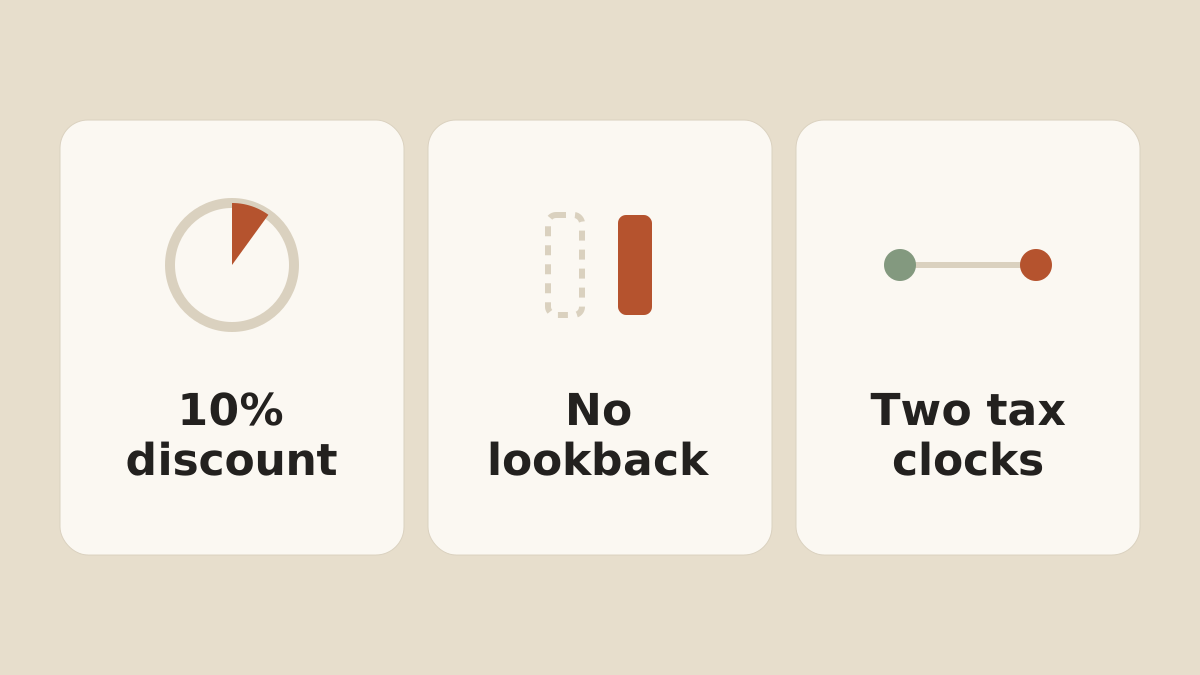
Intel's plan sets the purchase price at a percentage of the stock's market value on the purchase date. The plan document says that percentage can't be less than 85%, which makes the discount up to 15%. Intel's Compensation Committee can raise the percentage for a future period, which would shrink the discount, but it can't take it below 85%.
On a hypothetical purchase-date value of $30, an 85% price means you pay $25.50. That's $4.50 of value on $25.50 of your own money, about 17.6% before tax.
The discount isn't free of tax or risk. When you sell, it can be taxed as ordinary income, depending on how long you held the shares and what you sold them for, and step 4 explains how. It also isn't protected after the purchase. From that moment you hold ordinary Intel stock, and if the price falls by more than the discount before you sell, the discount is gone and you lose part of what you paid. The plan pays no interest on your contributions while it holds them during the period.
2. No lookback since February 2025
For years Intel's ESPP had a lookback. As Intel's 2020 proxy statement described it, the price was 85% of the lower of two values: the stock's price on the grant date or its price on the purchase date. If the stock rose during the period, you bought at a discount to the earlier, lower price.
Intel ended that with the subscription period that began February 20, 2025. The plan as amended in November 2024, and again as restated in May 2026, prices each purchase off the purchase date alone, and Intel's 2025 annual report describes the plan the same way. Some descriptions of the plan published since then still describe a lookback, so check the date of anything you read.
The lookback only made a difference in periods when the stock rose. When the price stayed flat or fell, the old and current rules produce the same price.
The plan lets the Committee set pricing for future periods, so confirm the terms before each enrollment window. Our video on how ESPP discounts and lookbacks work covers the general mechanics.
3. Contribution limits
Two limits apply, and for higher earners the second one can bind before the first.
The first is your election. You choose a whole percentage from 2% to 15% of your compensation, as the plan defines it. That definition includes base pay and payouts from Intel's Quarterly Profit Bonus and Annual Performance Bonus programs. It leaves out income from RSUs and other stock plans, and relocation and recruitment bonuses. If you're paid $180,000 in cash and $150,000 in vesting RSUs, your percentage applies to the $180,000.
You can't raise your rate during a period. You can lower it once, at the times the plan allows, and you can withdraw before the last 48 hours of the period and get your contributions back, without interest.
The second limit comes from the tax code. Section 423 limits how fast your right to buy stock can build up, to $25,000 for each calendar year, measured at grant-date values rather than the price you pay. Intel's 2026 proxy statement describes the plan's version as a cap on buying more than $25,000 in market value in any calendar year, determined when your right to participate arises. Purchases from both periods can count against the same year, and IRS rules decide how each period is allocated, so check your remaining allowance with the plan administrator.
Here's how the dollars work if your full $25,000 allowance is available for the year, the stock is $20 on every grant date and every purchase date, and the price is 85%. The allowance covers 1,250 shares ($25,000 divided by $20), which cost $21,250 at $17.00 a share. At a 15% election, contributions reach $21,250 on about $142,000 of compensation. Neither figure is a contribution ceiling for everyone. If the price rises during the periods, the same allowance covers more dollars, and if it falls, fewer.
To stay within the cap, the plan lets the Committee cut your payroll deductions to 0% partway through a period. The plan also limits each period to 72,000 shares and refunds the cash above that.
Whatever the plan allows, the deductions hold up to six months of savings for a single purchase. That money competes with your 401(k) contributions, cash set aside for taxes on RSU vests and ESPP sales, and anything you may need in the near term. How to weigh them depends on your household.
4. Qualified plan status and taxes
The U.S. offering of Intel's ESPP is designed to qualify as an employee stock purchase plan under Section 423 of the Internal Revenue Code. To qualify, a plan has to be approved by stockholders, be offered to employees broadly and on the same terms, exclude anyone who owns 5% or more of the company, cap purchases at $25,000 a year, and set the price at no less than 85% of the stock's value on the grant date or the purchase date. Intel's stockholders approved the current version of the plan on May 13, 2026.
Qualified status sets the federal tax treatment. Under IRS rules, buying the shares generally creates no federal taxable income. The tax comes when you sell, and how much is ordinary income depends on how long you held the shares and what you sold them for.
A qualifying disposition is a sale more than two years after the grant date and more than one year after the purchase date. With Intel's dates, the two-year clock ends later, roughly 17 and a half months after the purchase. Your ordinary income is the lesser of your actual gain or the discount measured at the grant date, and never less than zero. Because Intel's price isn't known on the grant date, the tax code figures that discount as if you'd bought on the grant date. At the current 85% price, that's 15% of the grant-date value. Anything above that is long-term capital gain. If a qualifying sale is below what you paid, you have a capital loss and no ordinary income.
A disqualifying disposition is any earlier sale. Your ordinary income is the full discount on the purchase date, the purchase-date value minus the price you paid, and it isn't limited to what you actually made on the sale.
Intel isn't required to withhold federal income tax on the ordinary income from an ESPP sale, and it isn't subject to Social Security or Medicare tax, as IRS Publication 15-B explains. Intel should still report it on your W-2, so the tax is yours to plan for. Our guide to safe harbor estimated taxes explains how to avoid an underpayment penalty, and our year-end tax checklist covers ESPP sales alongside RSU vests. If you also have RSUs vesting, our RSU Tax Gap Calculator estimates a possible federal withholding shortfall on those RSUs under its stated assumptions.
Check the cost basis when you file. Intel sends you Form 3922 for each purchase, with the grant date, the purchase date, the values on each and the price you paid. The Form 1099-B from your broker generally won't include the ordinary income in your basis for these shares. If you enter that number as it appears, you pay tax on the discount twice, once as ordinary income and again as a larger capital gain. The correction goes on Form 8949.
5. Concentration risk
Every six months the plan adds Intel shares. The plan document doesn't require you to keep them, though it lets the Committee require that they stay with Intel's designated broker for a set time. If you also hold RSUs and have part of your 401(k) in the Intel Stock Fund, the ESPP adds to the same position, alongside a paycheck from the same company.
Federal rules flag the risk, too. A 401(k) that lets you choose your investments has to warn, in your benefit statements, that holding more than 20% of a portfolio in one company's securities, such as employer stock, may not be adequately diversified. That's a required warning, not a recommended allocation. Intel's 401(k) restricts elections separately. Under section 12(b) of the plan, you can't direct more than 20% of future contributions into the Intel Stock Fund or move money so it exceeds 20% of your account, though market movements can take the holding above 20%.
Intel's insider trading policy narrows your options while you work there. It prohibits short sales, publicly traded options and hedging or monetization transactions, which it lists as including collars, prepaid variable forwards, equity swaps and exchange funds, for employees at every level. That leaves selling as the main way to reduce the position. Sales of ESPP shares are subject to the policy, so outside a prearranged trading plan you can't make one while you're aware of material nonpublic information. Trading windows apply to vice presidents and above (other than Intel Fellows), their technical assistants and chiefs of staff, and anyone with regular access to significant financial data, among others. Directors, certain senior executives and their technical assistants or chiefs of staff also need pre-clearance from Intel's Corporate Legal team before most trades. Prearranged trading plans that comply with the policy follow separate rules. Confirm which requirements apply to you with Corporate Legal before arranging a sale.
One approach is to set a ceiling for Intel as a share of your investable assets and sell ESPP purchases that would take you above it. Another is to sell each purchase soon after it's made, which turns roughly the discount into cash, before tax and subject to any price change between the purchase and the sale. Selling early makes it a disqualifying disposition, and if Intel rises after you sell, you give up that gain. Holding toward a qualifying disposition can reduce the ordinary income, though if the stock fell between the grant date and the purchase date it can increase it. Either way it means holding one stock for well over a year. Our video on holding too much company stock walks through how those exposures add up.
This is a summary of how the plan works, not a recommendation. Nothing here can tell you whether to participate in the ESPP, how much to contribute, or whether to hold or sell the shares. The right answer depends on your full financial picture, your other Intel exposure, your tax situation and your goals. The dollar examples in this article are hypothetical illustrations, not projections or results, and none of them can tell you whether or when to buy or sell. Plan terms can change, so confirm the current terms before acting.
Have a question for a CFP® Professional?
Schedule a complimentary 60-minute intro. Our pricing is a flat annual fee - this fee calculator shows how that compares with an AUM% fee.
Book an intro callDisclosures: The information provided is for educational and informational purposes only and does not constitute investment, tax, or legal advice and should not be relied on as such. It is not a solicitation to buy or an offer to sell any security. It does not take into account any individual's particular investment objectives, financial situation, or needs. You should consult your own financial advisor, tax advisor, or attorney before acting on any information herein. All investing involves risk, including the possible loss of principal. Figures and tax limits referenced are for the applicable tax year and are subject to change. Valence Wealth, LLC is a registered investment advisor in the State of Arizona. Registration does not imply any specific level of skill or training. Valence Wealth is not affiliated with, endorsed by, or sponsored by Intel Corporation. Plan terms are summarized from Intel's public filings and plan documents as of the date of publication and can change at any time. References to Intel stock describe how the plan works and are not a recommendation to buy, sell or hold it. Valence Wealth, its owner and its clients may hold positions in Intel stock. Hypothetical examples are not actual results or forecasts.
Sources
- Intel Corporation 2006 Employee Stock Purchase Plan, as amended and restated effective May 13, 2026 (Exhibit 10.2 to Intel's Form 10-Q for the quarter ended June 27, 2026)U.S. Securities and Exchange Commission
- Intel Corporation 2006 Employee Stock Purchase Plan, as amended and restated effective November 19, 2024 (Exhibit 10.6 to Intel's Form 10-K for the year ended December 28, 2024)U.S. Securities and Exchange Commission
- Intel Corporation 2006 Employee Stock Purchase Plan, as amended and restated effective February 15, 2022 (Exhibit 10.2 to an Intel Form 10-Q filed in 2022)U.S. Securities and Exchange Commission
- Intel 2026 Proxy Statement, Proposal 5 (Employee Stock Purchase Plan)U.S. Securities and Exchange Commission
- Intel 2020 Proxy Statement, Proposal 4 and Appendix B (prior purchase price terms)U.S. Securities and Exchange Commission
- Intel Corporation Form 10-K for the year ended December 27, 2025, Note 2U.S. Securities and Exchange Commission
- Intel Corporation Form 8-K, results of the 2026 annual meeting voteU.S. Securities and Exchange Commission
- Intel Insider Trading Policy (Exhibit 19.1 to the Form 10-K for the year ended December 27, 2025)U.S. Securities and Exchange Commission
- Intel 401(k) Savings Plan, as amended and restated effective September 30, 2025 (Exhibit 10.5 to Intel's Form 10-Q for the quarter ended September 27, 2025)U.S. Securities and Exchange Commission
- Intel 401(k) Savings Plan, Form 11-K for the plan year ended December 31, 2025U.S. Securities and Exchange Commission
- 26 U.S. Code 423: employee stock purchase plansCornell Legal Information Institute
- 26 CFR 1.423-2: employee stock purchase plan definedElectronic Code of Federal Regulations
- 26 U.S. Code 421: general rules for statutory stock optionsCornell Legal Information Institute
- IRS Publication 525: taxable and nontaxable income (statutory stock options, employee stock purchase plans)Internal Revenue Service
- 26 CFR 1.421-2: general rules for options to which section 421 appliesElectronic Code of Federal Regulations
- IRS Publication 15-B (2026): employer's tax guide to fringe benefits (stock options)Internal Revenue Service
- 26 U.S. Code 3121: definitions (wages excluding employee stock purchase plan stock)Cornell Legal Information Institute
- Instructions for Forms 3921 and 3922Internal Revenue Service
- Instructions for Form 8949Internal Revenue Service
- 26 CFR 1.6045-1: returns of information of brokers (basis reporting for compensatory options)Electronic Code of Federal Regulations
- 29 U.S. Code 1025: reporting of participant's benefit rights (diversification statement)Cornell Legal Information Institute
- U.S. Department of Labor, Field Assistance Bulletin 2006-03: pension benefit statements (December 20, 2006)U.S. Department of Labor